
Words and their underbelly.
It seems exasperatingly hard for a great majority of white people to be able to fully grasp the statement, Black Lives Matter. At first, I was confused about the resistance. Dennis’s teenage niece had posted on social media a really straightforward explanation/scenario (much like the one on the sign above):
“When the Twin Towers fell, everyone said We stand with New York City. Los Angeles didn’t chime in with, Hey, we’ve got problems, too. When the Boston Marathon bombing happened, everyone said, We’re all Boston strong. Cleveland didn’t pipe up with, Well, we’ve got a few things going on over here you should pay attention to also. After Sandy Hook, every single person stood strong with that community. Sandy Point, Maryland, didn’t feel left out. You put your heart where it’s needed most. Right now, Black people need us to stand with them.”
Yes. Yes. Her words were so simple and clear! Doesn’t that make sense? Go where you’re needed. On the face of it, of course it makes sense. But over the last week, I’m now feeling my way to the heart of why embracing and standing firmly with the words Black Lives Matter make so many white people get squirrely and why I felt a flutter in my stomach that clearly signaled my own inability to immediately say yes.
I had to really stay in that uncomfortable flutter and not explain it away as indigestion, something I ate. It was something I ingested, yes. A long time ago, without even being aware I was swallowing it. A way of being and thinking so deeply ingrained in me that to go there requires a weird kind of inside-out flashlight I’m just now getting batteries for. As I went in deeper, trying to figure out why that young girl’s sign above was saying it so clearly, and why still the flutter in my stomach and the refusal for so many to gather around and say the words, I found I was looking hard for an enemy to unload all my righteous anger on. The police union, right…gotcha. Sure, yes, but not altogether. Flutter check still in play. More enemy out there.
Every crisis needs one. A baddie we can all pull together and defeat. As Dennis’s niece’s very logical example above suggests, America has focused its fury before. September 11th featured men in the desert, in caves, in a land far away who believed in a radical ideology that very clearly wasn’t the American way of thinking. They needed to be stopped. There seemed common agreement on that. Ah, we’ll do something. Send troops over there. Now. (Troops, that, according to an analysis by the US Army in 2013, found African Americans continuing to serve in disproportionately high numbers. But I digress.) Then, a good majority of us queasily realized, well, oops, maybe those aren’t the right people in that country that we’re killing in retaliation. But, hey, we’re here now. they must have done something. When the Boston Marathon bombing happened, again the search for an enemy, and oh boy, that kid was radicalized. That damn ideological difference that comes from those people we’ve been trying to stop (or stir up, as has been extensively written about). When the tragedy happened at Sandy Hook, we all mourned and many took up the cause for gun control and mental health reforms. Tragically, movement on those fronts have not budged much since then either. (I’m looking at you Mitch. And stop me before I digress into that rabbit hole.) So there you have it, crises that brought America (mostly) together to utter words suggesting change. “Never Again” is a phrase that has been used for all of the above and carries rich history.
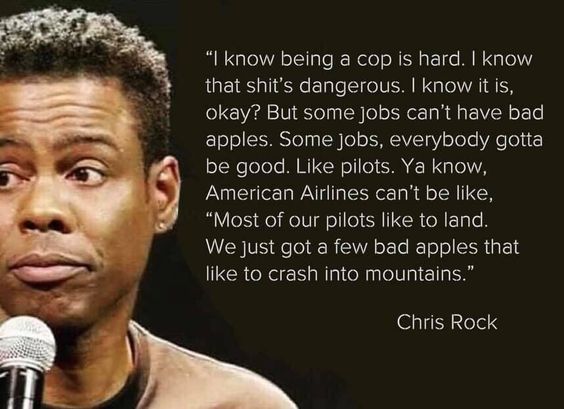
So what about Black boys, men, girls, women being killed weekly by police? (I know that Black people are also killed by non-cops and citizens of all colors, but for this particular argument, I’m keeping it tight on law enforcement because police, we’ve been told, are meant to protect us and that whole “bad apple” theory is just not holding anymore. See Chris Rock for a good perspective on that. But I digress.)
While turning toward the police and their union does present an immediate villain. Sure, many are uncomfortable or just plain unsure of where to start in rehauling policing in America. I know I’m still learning and reading and coming to the abolish side, which on its face sounds so so radical, but really really isn’t. (good points. Great reading.) But when faced with the phrase Black Lives Matter and the resistance to it, clearly there’s something deeper and more personal going on than blaming systemic police misconduct. When I continued on into myself with that damn flashlight, I came up squarely face to face with myself. What? (Bangs flashlight on head. clearly flashlight is broken. No, not broken.) There was an awkward pause. Would rather not. Look, shiny object. Runs away chanting All. Black. Lives Matter. Sticks head in sand. Makes excuses. Rinse. Repeat. Yes, that’s been me for years now.
More dead Black boys and girls and men and women.

Where to begin? “One thing … is that part of being an ally is taking a deep breath and getting past the shame and the guilt that you’re carrying, because white people who are alive today did not create racism. They didn’t choose to live in a white supremacist country, and they didn’t choose to exist in the world that we do today. But what they can do is choose to admit that they benefit from racism and acknowledge that they have the power to change the conditions, and that’s crucial, because this isn’t a blame game.” Ben O’Keefe, former senior aide to Senator Elizabeth Warren (to read the whole article, please click here. so effin’ good),
Okay, so while now it may be slightly easier to look in the mirror and not feel constant hot shame, I have to keep looking and learning. Those words are a call to action to finally understand American history and how Black lives have never mattered in this country. (I realize that pretty much every piece of land on this planet has a racist origin story soaked in blood, but, again, just focusing on where I live. Maybe a ripple effect.) History from grade school on up has of course been spun meticulously from our white founders and ancestors and on to other white (mainly male) people in power from there. Given their authorship, why would they want to shine any light on the stories of indigenous people’s displacement, the bringing of black bodies to this country against their will, selling them as property, using their bodies for labor and sex, telling them they’re free, continuing to abuse their bodies with labor and sex, enslaving them economically, refusing them the right to take part in the shaping of the country politically, ethically, or humanely, then hanging, beating, and murdering them on the regular, and very rarely having anyone held accountable for any of it. Which brings us right up to June 2020. When do history books get sent back for revisions? Of course, the stories are shameful and made more so by their being hidden in plain sight. Like that damn cherry tree Washington didn’t cut down. It feels like America needs to be engaged in a giant racist anonymous group. “Hi, my name is America, the United States of, and I have a problem with racism.” Because as they say, the first step is to admit it. We could all find fellow White buddies willing to do the work to keep us on track. But, again, I digress.

I’ve started to dig up the bodies buried deep inside myself. All the times I know I’ve stood by and ignored a comment because I just didn’t want to make anyone uncomfortable. When I haven’t stepped in when a Black person, whether friend or stranger, was slighted in just that subtle way that’s confusing. That, did that just happen? Oh, I’m sure I misread the situation or I know my friend can take care of themself. But that’s not the point. Of course, the very fine human next to me can take care of themself, but I’m the one who needs to act on my outrage. Claudia Rankine’s “Citizen: An American Lyric”—a book-length poem so worthy. An hour to listen to audio-wise, available from the library—has a very excellent moment about that. The times I’ve said something offensive, mindlessly carrying on. I need to listen to my own self and pay attention to the outrage.
Currently, America is pandemically challenged on a lot of levels: health, race, politics. If I can begin to be honest about how to be a racially smarter, more honest human through listening, reading, understanding, then maybe by the time Dennis’s niece has a few more decades under her belt she won’t need to be explaining to her really dense elders the logic of go where you’re needed. And hopefully, Black Lives will actually matter. Those three words won’t have become sloganized like World’s Best Coffee or Never Again having lost power and become selling points. (Which, considering the almost-one-hundred emails in the last weeks from retailers to banks whose subject lines have used Black Lives Matter to indicate they get it only really resonates if they’re donating masks, money, offering loans to black-owned businesses or otherwise using their platform to help. But I digress.)
Right now, what I’m reading and listening to in order to understand what I want to understand, along with my noticing of previous choices that have been my go-to, Eurocentric pattern. I still enjoy the then column below, but recognize the narrow focus I’ve operated under since, um, forever?:
Podcasts:
NOW: The Stoop (poignant, pointed storytelling. Black perspective. Episode 39: For Irma. incredible. click on link) ALSO: Scene on Radio (stories exploring human experience and American society from the Center for Documentary Studies (CDS) at Duke University. Especially amazing episode: More Democracy)
THEN: This American Life (poignant, pointed storytelling. 98% White perspective). Radio Lab (stories exploring human experiences. 98% White perspective).
Books (nonfiction):
NOW: White Fragility: Why It’s So Hard for White People to Talk About Racism by Robin D’Angelo (Up front discussion of an American problem.)
THEN: Educated by Tara Westover (The journey of a white woman finding her way out of a cult and into an education.)
Books (fiction):
NOW: The City We Became: A Novel by N.K. Jemisin (urban fantasy novel set in NYC that deals with how we are all the other.)
THEN: The Grammarians by Cathleen Schine (funny novel set in NYC that deals with wordsmith types who feel they are the other)
To Watch:
NOW:
When They See Us by Ava Duvernay (episodic series based on the true story of the Central Park Five, NYC)
THEN:
The Morning Show (episodic dealing with the #metoo moment loosely draped around the Matt Lauer GMA moments, NYC.)
Daily Work:
NOW:
21-Day Racial Equity Habit Building Challenge (fantastic helpful day-by-day interactive for opening of eyes)
THEN:
The Artist’s Way, which I’m just beginning again, so don’t have a real racial perspective on.
Please share what tools, books, listening you’ve been doing to open your heart and eyes. I can use all the help I can get! And thanks!
 Does This Make Me Look
Please, Lauren, check your information… As you know, Doug was an officer in the military for 21 years. We discussed you comment about more “blacks and browns” being killed in combat. That is not true… many more “whites” were killed – and many “blacks” weren’t drawn to join the military. These are my words, taken from what Doug has known in the military for those years… so, please don’t split hairs regarding my summary… This comes from Doug’s life experience through those years of his close combat (two tours in Vietnam and many years in Europe). He even has shrapnel in his hand as evidenced by “close combat” – as a platoon leader of his troops. Just an FYI for your “book of knowledge.” Always good to read…
LikeLike
Thank you for pointing out that I really wasn’t as clear as I needed to be! I did just clarify my meaning on the post as I was talking specifically about the Iraqi incursions and the percentages there. (I’ve included my source.) I didn’t in any way mean to disparage Doug or any service members at all, but did want to point out that for African-American’s enlisting in the last incursions, although a choice, it is one that still reflects a systemic racist perspective as there are still very few African-American’s who rise into the upper echelons of the military. Here are sources I pulled from PBS Newshour: https://www.pbs.org/newshour/show/why-the-u-s-military-hasnt-made-more-progress-on-overcoming-racism and the Philadelphia Tribune: https://www.phillytrib.com/news/minorities-continue-to-pay-a-high-price-for-iraq/article_80d3ee27-ef47-56c9-926a-c2c613cbdd72.html
According to an analysis by the U.S. Army – the service branch with the highest proportion of Black enlistees – the number of African-American soldiers has declined since the 1980s, when nearly a quarter were Black. But African Americans continue to serve in disproportionately high numbers. In 2009, 18 percent of the total Army population was Black, and African Americans comprised 21 percent of active-duty enlisted soldiers, the Army reported.“Because many Blacks don’t have traditional advancement opportunities – good schools, family college funds, etc. – it makes sense that so many would turn to the military for a leg up,” Jefferson observed. “It’s a choice, but it’s a choice fraught with lots of racist historical baggage.”In Iraq, Blacks made up an average of 15 percent of combat troops in-country at any given time, and in the earliest weeks of the conflict accounted for a startlingly high percentage of casualties. However, due largely to their concentration in non-combat positions of the military, by the end of the war African Americans accounted for just 9 percent of fatalities – which is actually lower than other ethnicities.
Race, Gender & Class Journal: https://www.jstor.org/stable/pdf/41675292.pdf?refreqid=excelsior%3A7f0d63d676c5ba6cf0d0b2c37115adf7
LikeLike
Go girl. Love you! x
LikeLike
Amazing as always.
LikeLike