
In a world where a girl buys a new set of colorful masks (spring/summer collection) because she’ll be going out and about a bit more often given her fully vaccinated status (as of last Tuesday) and then the CDC says “go ahead, take ’em off, frolic bare-faced among the people,” well that girl (who is me) thinks, Huh, I’m still going to wear these masks when they arrive because I’ll just feel better doing that. Is it because I’ve become so well-conditioned to wearing them that it’s second nature? (Like putting on shoes.) Because I’m still legit unsure of who among my fellow travelers is vaccinated, and even though I can’t spread the virus, then subsequently infect my loved ones, so the science is finding, I still feel weird about having my face exposed? Probably a bit of both. Everyone has developed their own gauge of risk assessment in this past year+. And most of us have probably also developed a much more honed muscle of resilience around all the many experiences life has thrown (& continues to pitch) at us daily. Last year the rollercoaster ride of personal, medical, global, racial, political, climate events—plus a whole host I’m sure I’m forgetting—invited us to strap in for the ride. Some maybe chose to ignore a couple of those cliffs and dips, but keeping as emotionally limber as possible seemed to strengthen a muscle in me that has me more able to deal with the unknown. A lot of that has certainly come from the stun of months that kept me in a state of both quiet terror and loud rage. But also deep appreciation and discovery of strength. I’m a damn sight closer to being more confident around cutting through emotional BS than I was in 2019. The moments I used to go along—in conversation, in emotion, in agreement—because I didn’t want to raise a ruckus, rock a boat, upset someone, has become more and more uncomfortable. I have way more in my emotional workout to lift, but a little flex here and a stretch there is keeping me moving. That old chestnut patience—a key word during these Covid times along with epidemiology and pods—pops up frequently.

This week at my volunteer gig, I was paired with a young woman who, for the seven hours we sanitized clipboards together, told me about her life. Very matter-of-factly. Her uncle had just died and his girlfriend was suspected of overdosing him, her ex-boyfriend had just died mysteriously. Her dog had died the day after she’d broken up with said boyfriend. Her half-sister was in foster care. Her mother’s boyfriend was not lovely in ways she didn’t describe but looked angry about. Her grandmother, with whom she lived, had been evicted from the house she’d lived in for three decades at the beginning of the pandemic. Now they both lived with her dad. Her current boyfriend’s family does not approve of her and is tracking him by GPS to make sure they don’t see each other. I was wearing my mask (a beautiful embroidered one my friend Judy sent me) and it caught my jaw over and over again. But here’s the thing, these moments were not delivered as woe-is-me. They were interspersed with fantastic ideas about how to help with refugee resettlement, ways to house the homeless, suggestions on including mental-health advocates during police interactions. How she stopped going to UC Riverside and enrolled at the community college so she wouldn’t rack up debt while she decides what she wants to do big-picture. Whether she might convert to the Muslim religion. (Her boyfriend’s Egyptian, she’s first-generation from Mexico.) She speaks Spanish, a bit of Arabic, and thinks she wants to study abroad. Or maybe move to Maine where one of her friends is going to college. She’s twenty-one and all this is of course early adulthood. Except that the moments of personal death and loss seem a lot. I was reminded how differently my youth unfolded. Of course it did. I had definite privileges as a white girl that she hasn’t had as a Latina woman in this country. The death and disease I witnessed, and/or experienced in my early-adult years did, in memory, contain the elasticity of youth, but every moment ended up somewhere inside to be dealt with at one time or another. And over the years, looking those moments in the eye has been really key in understanding why I react to things the way I do. My volunteer partner reminded me that resilience in the face of what life serves up, how we talk about it, then process, makes a world of difference in how we live on this planet. No matter how much time it takes.
Around this Redlands neighborhood, I’m noticing both the absence and presence of resilience in more personal terms. Next door, there lives someone who is angry in a way I haven’t been near in ages. It’s bald-faced misery. No secret. I’ve known people, and also been myself, miserable on the inside, but with a sheen of “it’s fine” on the outside, which fashions its own special hellscape, but this guy wears it for all to see. He is the caretaker of his 95-year-old grandmother and it’s clearly something that is slowly (quickly?) driving him mad. We all see it, we all hear it. He lets us know he’s misunderstood and taxed in ways no one can understand. That’s true. No one can know what someone else is going through, although he is not shy about letting us see his pain. It’s the daily explosive yelling events that are the biggest signpost. Usually aimed at a girlfriend who for the last many months has been there pretty regularly. And each day they yell, “you don’t understand.” They shout, “you don’t care (enough).” And it’s exquisitely sad and scary. I keep wondering why she keeps coming back, but can’t know their cycle of drama. Do they think this is love? Their form of resilience? Always bouncing back to each other on repeat? Dennis and I have talked about what to do if it sounds like Grandma is being abused or if it becomes physical. Last night it seemed to come close. A particularly explosive event: shattered glass. Crying. Silence. Murmured fury. We listened and I wondered if it was time to call the police, which is something I’m so disinclined to do for a variety of reasons. When she left soon after and we heard the sound of the vacuum, I thought now it’s done. surely no more. Jury’s still out on whether that’s true, but there’s no doubt that anger consumes. And resilience is not a thing with feathers in this case.
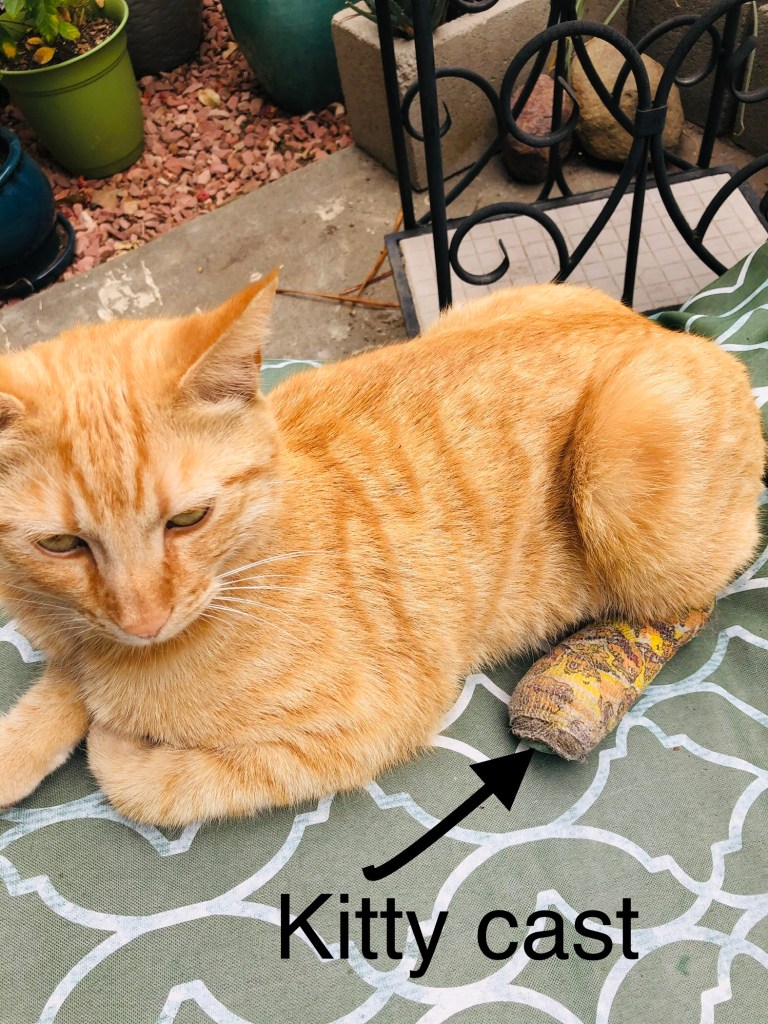
What is? Apparently, a furry creature who doesn’t speak my language gives a good example. Gladimus the cat turned up last week with a cast on her/his leg. Except for shaking it a bit as if it might just pop it off with the effort, Glads is loping along like always. Under the fence, napping on the chaise lounge, running along the sidewalk, chasing things. And when in full flight, the cast tap-taps on the ground like a kitty-fied Ginger Rogers in the catly Rockettes. Vigorous leg shake, tap-tap on the ground, leg shake, tap-tap. What’re you looking at?, she throws me over her shoulder as she heads off to explore the many mysteries of the landscaped bushes. I’ve got this.
And, yeah, she does. I look to her. Thinking that’s some resilience.
 Does This Make Me Look