Something I’ve come to appreciate spending time with my dad over these last years is the necessity to check my own ideas around what it means to age. How seemingly impossible it is to control how things unfold in body and mind. Time is a slippery bastard, slowing down/speeding up/hiding and seeking. Running alongside that, I’ve noticed how time has it’s way with reality. Or at least what some so-called lucid person might consider reality. I call myself lucid—most of the time—and so do the majority of people I know. I fully get that to be considered lucid (MW definition 2: having full use of one’s faculties : SANE) is what folx aim for so as to be believed at best and not shunned or disappeared at worst.
This week my dad, Dennis, and I went to visit my dad’s oldest friend. Literally. He’s 96 and so is my dad. They’ve known each other since before I was born. Six+ decades. It’s been a year since we’d seen this friend and a lot had changed in that time. Sitting in his living room, I had a moment of panic around not being able to ride his train of thought. His stories toeing at the line where that veil of what is (or at least the what is that may pass for reality: day, time, the structure we sat in) fluttered a bit to expose the things he saw in his particular world at present. I pretty quickly realized it didn’t matter if I could follow him. He didn’t expect me or any of us in that room to. His current moments were gauzy and took place somewhere none of us were privy to, yet he was present in the room. Not delirious at all. Totally matter of fact about things we couldn’t see, but he could. And it wasn’t important to him for us to see them. He was simply existing in his own corner of the world. But when my dad would bring up friends from back in the day, places they’d gone, people they’d seen, the friend was right back there with him in that moment. It was only the present that offered these other paths into other stories with different sights and sounds than the ones the rest of us might see.

Memories. They kick ass. They catch hold, barely hanging on in some cases, getting a boost occassionally, like when I walk through a smell and think, Damn, Love’s Baby Soft perfume. High school, that boy in guitar class. such a crush. wait. I think I thought he liked me, then he made out with someone else in the hot tub. Ouch. that sucked. And didn’t the security guard at our apartment building yell at us for pouring Mr. Bubble into the hot tub. Now that’s a weird smell…and on like that. Or a car passes and a snatch of Heart’s “Barracuda” escapes and I think of these platform sandals I had the summer I loved that song, then have an urge to find a pair of sandals just like them. Until I remember: who’m I kidding? I don’t wear platforms anymore. Too far to fall. And on like that. But talk about untrustworthy. sheesh. Memories are the ultimate unreliable narrator.
Listening to a podcast, Dead Eyes (very funny. Comedian/actor Connor Ratliff talking about his firing from the Tom Hanks mini-series Band of Brothers and trying to understand why it happened) and this bit about memory as explained by psychologist Elizabeth Loftus by way of Adam Ruins Everything creator Adam Conover: “Our … understanding of memory, the way we talk about it with each other, is that it’s a recording device. Things happen to us and we record them, then we can go and play the tape back. But even when you look at your own experience of having a memory, that’s not what it’s like. You’re not playing it back directly from some spool of tape. You’re imagining it based on a story you’ve told yourself….[but] it’s not a tape, it’s more a Wikipedia page and you can go in and edit it, but also other people can go in and edit it by talking to you or asking leading questions.”
That’s one trippy thing about writing fiction, sometimes I’ll use a story that I experienced or was experience-adjacent to and I’ll alter it for the story and then naturally the one I just wrote becomes the truth.
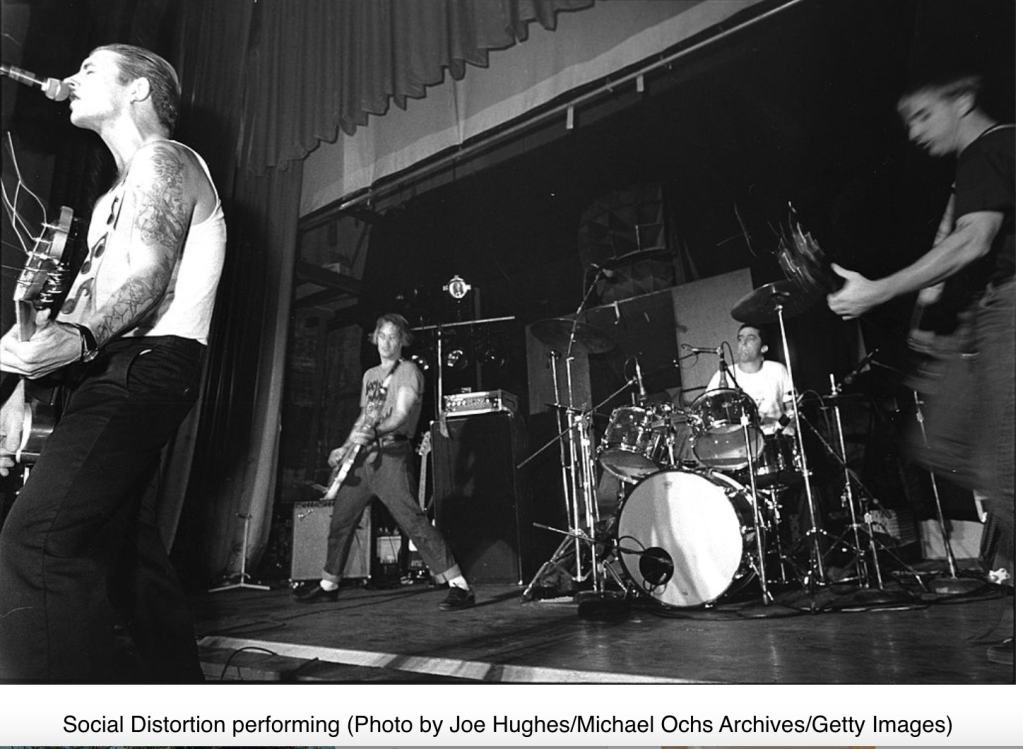
The second feature article I wrote at SPIN was on the band Social Distortion. I was flown out to San Francisco to hang out, see a show, like that. I’d known the band’s music from early college days in Costa Mesa, Irvine, etc. A southern california punk-put-in-a-blender-with-rockabilly (also known as cowpunk) sound that was a trademark of the area along with Blood on the Saddle, The Gun Club, etc. Social D. had (have?) a hardcore following decades deep. On arrival, August 1991, the bassist had decided he wanted to get his belly button pierced and so had set off with the record company’s publicist to get that done before they played that night. A few hours later, when he showed up at soundcheck, his eye was purpling into a very obvious shiner. The publicist explained that he’d fainted during the piercing, fallen off the table and blackened his eye. By the time the fans were muscling in for the show, carving out space in front of the stage for a mosh pit, his eye was officially black. As he stalked back and forth at the lip of the stage, the crowd became curious. “Hey, what happened?” “gnarly eye” and so on. His story, one that in my memory includes “You should see the other guy”-posing was just what the audience wanted to hear. A living, brawling tough guy taunting the jagged soundtrack of his life full on—or at least that’s the image he was playing in public. For me, this was journalistic gold. The mythology of toughass brawler while the truth was much more queasy clumsy. And when I wrote the story, that was my lede.
Looking back, I’m proud I actually did use that bit to start the piece given both the band and record company were not at all happy about the image I spun. I knew they’d be annoyed and since I was new to this music business game, I was still (always) in pleaser mode, wanting nothing more than to make the artists happy. I had zero investigative desires. But in that moment, I knew I couldn’t pass up the rich metaphor. Then, decades later, I wrote the scene into my first novel: Nine Inch Nails (alternating with Einstürzende Neubauten) were playing in the background. The piercing person was a tiny extremely cool young woman with spiky blonde hair. A red velvet curtain separated the waiting room from the tables and instruments. The bass player sat on the table, his legs dangling over the side, morotcycle boots scuffed, the chain on his wallet clattering as he fell in slow motion forward as a very long needle came at his midsection. Her pissed, him mortified once he came to.
But none of that happened. I’ll never know what it all looked like because I wasn’t in the room.
It’s tricky stuff the bleed between the real and the remembered. And distinguishing between memory and deception. The question of what is gained by telling a story a certain way. Sitting with my dad’s friend, his world was rendered in all the colors and spaces he’d created. For no one else, which seemed a sort of freedom, which was also a story I told myself before admitting I have no idea.
 Does This Make Me Look