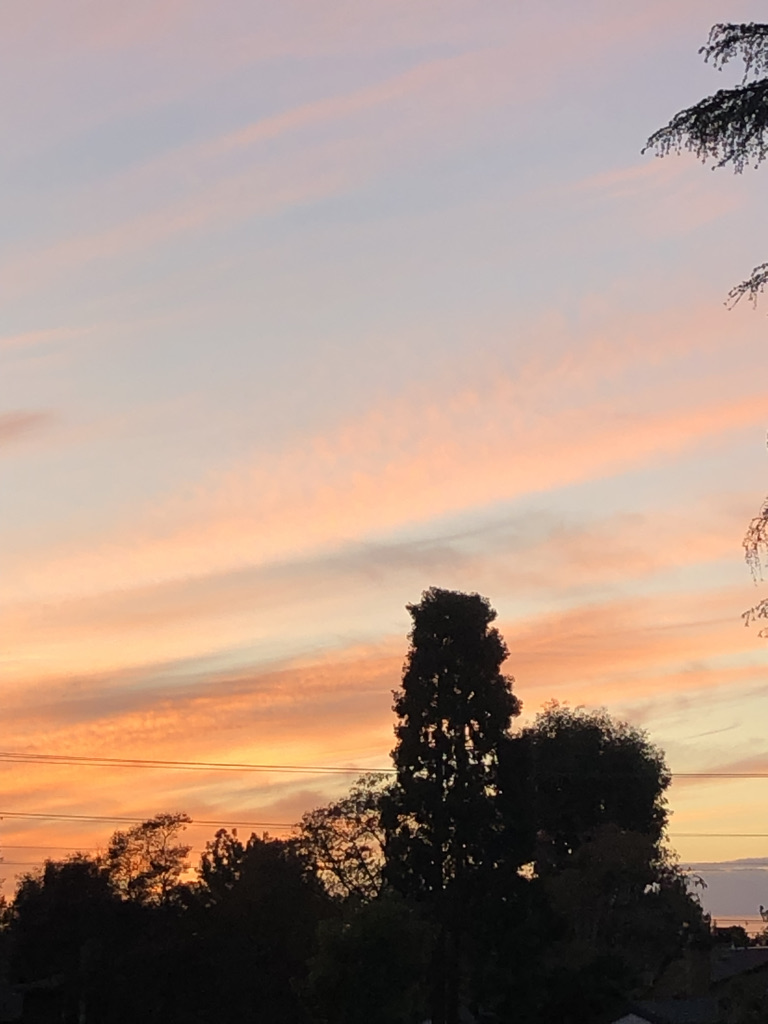
We’ve had a lot of rain here in Cali. Maybe you’ve heard. An atmospheric river rolling through the sky bringing storm after storm up and down the coast. Then there are the sunsets during cloud breaks and those are pretty stunning (sunrises are nice too). Being someone who likes seasons, I mean I moved to NYC so I could enjoy outerwear ferCrissakes, I haven’t been mad about the groundhog’s day cycle of sun into clouds into rain into … etc. But I also haven’t experienced the drama of the areas in the state where flooding, mudsliding, power losing has been happening. Those folx are no-doubt feeling differently than I am as I wander around going gaga over the pretty colors in the sky.
And wander I do. Because my work schedule is on East Coast time, I’m done mid-afternoon so I can exit the apartment and walk around. This town (er, much of the country) isn’t really built for walking. Sure, Redlands has its share of great neighborhoods—cool Victorian, Craftsman, adobe-style houses, a beautiful park, a verdant cemetery, all uphill, which makes the views once you get there pretty great—but when I wander outside those locales, I’m walking along thoroughfares lined with car dealerships, tire & fix-it shops, or stretches of fast-food joints (so.many.fast.food.options). Sometimes I’m walking along a stretch where there are no sidewalks as if the city planners were just all “why waste the concrete?” I’m always listening to something and given most of you are probably aware of my aversion to music currently since I’ve written about that state of things fairly extensively of late, I’m either into a podcast or an audiobook. During my stroll yesterday I was listening to Atul Gawande’s Being Mortal. Sheesh. His full-on focus that modern medicine, specifically as it is in the U.S., around end-of-life moments is clear-eyed and thought-provoking. (For those of you who haven’t yet thought about or committed to paper your end-of-life decisions, here’s a source myself, Dennis, my dad, and my mom used.)
Anyhoo, there I was walking around trying to find all the sidewalks, listening to the measures medical pros will often go to in order to prolong a life sometimes at the expense of the person involved. No doubt I was making crazy faces, which really, who cared given I was literally the only pedestrian for miles, and if the drivers noticed, they would have already thought I was eccentric for walking. The stories in this book are compelling with varying levels of tragic. These are firsthand accounts of people’s lives in all their pathos, hope, success, failure. The overriding point: that we as a people and as a society, whether medically trained or plebian inclined, do not really function well around mortality and the impending loss of it. Of course we don’t, or rather I’ll shift it back on me, of course I don’t given my exposure to end-of-life is not at all constant. Versions of death exist on a screen. In a book. I can feel the emotions around the loss if the story is done well. That’s it. When Dennis’s mom died of cancer, I could see how the loss rippled through him and his family. I could understand the choices she made to take control of where she wanted to be at the end of her life, which is precisely what Gawande’s book talks about. With modern medicine, there are now myriad ways and choices to keep a certain type of hope alive yet the conversations around the reality of what that means (months in a doctor’s eyes, years in the minds of most patients) are usually pretty skewed and often quite confusing. Back in the day, if you made it to eighty you were some kind of miracle. George Washington died of a cold, so did President Harrison (barely remember him as he was only in office for a month in 1811). Other presidents succumbed to various things that today would be cured by a short stint on antibiotics or in a hospital. I’m not saying it’s a bad thing to prolong life, just observing that not talking about what life will look like after an intervention takes place can open up a pandora’s box of perpetual expectation and confusion. Also often fear and disappointment and/or anger.

So all of this while I negotiate conversations with my dad around where he’s at presently in living his life. Our current round&round is about driving. He’s incredibly close to handing over the car to me but it’s a lot of one mile forward, two clicks in reverse. It’s not lost on me that this decision goes much deeper than just having a big hunk of metal with an engine inside parked in your driveway. This is about autonomy. Giving up the automobile means acknowledging exactly what his capabilities are and where he is in his life. This choice would not be temporary. Once that car is gone, he will never own one again. Will never drive again. That is huge in selfhood and ego. But yet, for me, it’s about safety. On January 24th he’ll turn 97 and his license will expire. He could renew it. Yet given a few variables—the state of his memory, the physicality of getting in and out of the car, which appears to be more challenging of late—it seems a better moment would be to hand over the keys. We’ve talked about grocery shopping and doing errands together. I’m all for it! Think of the adventures! But again, his sense of autonomy adjacent to my safety worries. Last week at his local store, he hit another car as he pulled out of his parking space, knocking off a bit of plastic from the front headlight. The other driver claimed no damage and let the thing drop, but still, as I do, the thoughts of how much worse it could have been circle the drain in my brain endlessly. So have we reached the point where I become the decider? Dennis reminds me that the time comes when I have to step up and do what has to be done even though my dad might not like it. Other people tell me similar things about stuff that just needs to be done whether he’s into it or not. I exist in the gray area, which even as I write feels somewhat cowardly. Although I’ve gotten a helluva lot better at instilling the importance of his cane or the rolling of the trash bins down the driveway once a month in the face of his grumbling that he doesn’t like his cane and can still move the bins, I recognize my flee-from-conflict instinct. Of course not taking the lead will bring us right into a conflict of another kind. The type neither of us may have control over if something dire happens. My dad and I have had more hard conversations in the last year than at any point in our relationship but there are more in store. I look for the sidewalks that might border these big important issues where we can safely exist, him with autonomy and me with peace of mind. On the lookout for bravery, heading down that freeway of love (thanks, Aretha) in the slow lane. (Corniest metaphorical ending I think I’ve ever written. Um, sorry?)

 Does This Make Me Look
Lauren, this made me think of my dad and his love affair with his car. Dad was severely handicapped but able to get around on crutches and drive using hand controls. Until he couldn’t anymore – bedridden for his last few years. But Would.Not.Give.Up.The.Car. It just sat in the driveway collecting spider webs. I think he saw that car as his independence and if went, well then… You are a good daughter.
LikeLiked by 1 person
Ronda, your story about your Dad makes so much sense! In the context of independence, I think that’s what’s happening with my dad as well! Thank you for sharing!
LikeLike