Hustling (the Final Installment)

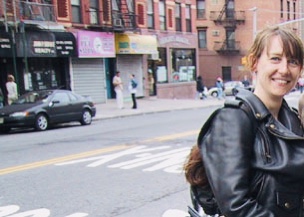
My lovely friend Shazna cheering me during the marathon of 2009

In the summer of 2007, I finally moved into my one-bedroom apartment in upper Manhattan, Washington Heights near Ft. Tryon Park. I’d continued running and the year before had stood on the sidelines cheering on my friend Shazna as she ran her first marathon. We’d begun to do miles together on the weekends, entering various NY Roadrunner races to tick off the list so I would qualify for November 2008’s marathon. At the time, this activity was honestly the thing that saved me from swirling down into an emotional sinkhole. Something about doing something that completely centered me around endurance distracted me from wallowing in sadness as I began to figure out what had happened over the last almost-decade that led to my marriage imploding.

Honestly, it’s not as if I’d thought the guy and my relationship was solid in all ways but it hadn’t felt altogether perilous either. When we’d told people we were divorcing there was often a funny reaction to do with “Oh, shit. If it could happen to you guys, then what about us?” This wasn’t really a selfish response across the board but more to do with the fact that we always seemed to be enjoying each other’s company, never any tension. And really, perhaps that was the problem. Or more to the point, there was so much more going on under the surface that even I was unaware of, or rather, unwilling to explore, which led to the ending.

So when the house in Brooklyn was finally sold and my apartment finally moved into on a hot summer’s day, I was unpacking more than just boxes of books and cutlery. I was unpacking a whole lot of trust issues along with sorting through how to begin again. I’ve always enjoyed spending time alone—perhaps this is a byproduct of being an only child—but obviously this was a new kind of alone. The kind where it became important to think about what I wanted for myself in romantic relationships, or rather whether I wanted one of those again at all. My trust had for sure been blown up because although when the split first happened, I’d been under the impression that the guy was being brave having just discovered something about himself that he needed to reveal in order to step into and begin his authentic life. But, as it turned out, and as he ended up telling me right after I’d moved into my new place: He’d been disappearing regularly during workdays and in the middle of nights for the previous year before our break and engaging in riskier and riskier sexual behavior. He’d been living that double life for a while and now that I knew that, I couldn’t understand how I hadn’t actually known that. This was where the trust disintegrated, certainly in him but also in relationships in general, and specifically in my own emotional meter. The one that I had always thought would quiver with a “something’s not right” breeze in the still of the night or the quiet of a feeling. But that hadn’t happened, which shook me.

Also, my body. I hadn’t listened to it intimately maybe ever. The running felt good in a physically exhausting kind of way, which was a joy on its own merits. But there was another movement moment I became involved with at that time in my life that connected me to myself in a more inward way, although it was something that also required a helluva lot of strength. I’d stumbled across it copy editing a story about Kate Hudson where she talked about a place called SFactor where she’d taken some classes maybe for a movie role or some-such. She had described her workout there as “feminine movement and pole dancing” and I’d immediately been curious. Pole dancing? This appealed to me on a lot of levels that I couldn’t immediately put my finger on. It sounded taboo, which appealed to me. I’d immediately gone online and found SFactor had a Manhattan studio and an intro where you could go take a two-hour class to see what it was all about.

I did that and for 120 minutes, I found myself in a darkened studio with no mirrors and about a dozen other women. When I say found myself, I don’t mean that passively. It was an incredibly active thing that was going on inside of me as the instructors led a class of floor movement and then for the last 15 minutes did some things on the pole that were so incredible that I both fell in love with them and thought I need to be able to do that. I also cried. A lot. At the time I wasn’t altogether sure what I was crying for but it felt necessary. When I looked around in the dim light at the other women in the room, I saw groups of friends laughing, buddies bonding, and maybe one or two other women like myself having some sort of emotional reckoning, but honestly, as I think back on it, I didn’t care at all about anyone else in the room except for the two women leading the class. In that moment I felt I might follow them into any number of dimly lit rooms in order to understand and go deeper into the hows and whys of this movement. Power and abandon, two things I’d never really known how to achieve yet desperately wanted to explore.

Within the year I would have a pole of my own in my new apartment. I would meet and build a fierce community of women both at the studio and in running. I would begin to discover a lot of things about myself while also learning how to submit receipts for pole dancing to the Condé Nast fitness program for reimbursement. And I would begin to find my way into a more real sense of myself. None of it without some trips, falls, and weird-ass moments.

Those will come during the next series: Body Parts. Suffice to say that this series, Hustling, has been clarifying. Writing about how each of the places I’ve lived in all the boroughs of the city since the jet plane from California touched down at JFK and released me into my Manhattan life has brought me around to understanding the ways I’ve grown and how that all prepared me, during my third summer in that one-bedroom uptown apartment, to be ready when I met a man who lived a dozen blocks south and we had our first date, riding our bikes to the Little Red Lighthouse where we ate a picnic and I decided I’d like to enter into another chapter. It’s an ongoing series that he’s still a part of, and which is also changing constantly. I’m so happy for that!

I may take a break here for a minute as I gather my thoughts for the next series. It won’t be long. Thank you for being here.

Still Hustling (After All These Weeks)

The guy and I left our Windsor Terrace brownstone in a rental car early on a Saturday for a wedding in Connecticut. About a quarter of the way into the hour-ish drive, he asked, “How do you think people see our marriage?” Or something to that effect as the decades have shaped this question into a mirage-like memory. Also, at that point the thing I remember most is thebuzz&ring inside my body and between my ears. I didn’t fully understand the question and probably asked something like “What do you mean?” The long&the short of it, where he was going with the whole sideways intro into the conversation was: I’ve discovered I’m not into women.

Naturally, this both terrified and explained a lot, especially when it came to our nonexistent intimacy. There was a flash of So it’s not me that lit up like neon, then fitzed out when the next thought of Sh&t, change is coming buzzed in. I did. not. want. any. change. at. all. Ever. But as I vibrated with that, he was still talking, telling me how over the last many months, he’d discovered, while online in his basement office late into the night, that his sexuality was oriented in a completely different direction than what our relationship pointed toward. That he’d been truly agonizing over it for a long, long time. How it felt so good to finally say it out loud.

That was about the time we pulled into the church parking lot and I stumbled out of the car and spent the next few hours watching two friends say sweet things to each other about forever and love, then pretended to care about joy, the chicken option for dinner, the cake smashing scene for dessert, and dancing at the reception. I cared about the wine drinking.

On the way home, I had landed in some sort of bargaining stage and told him we should do an open marriage setup. We could stay in the house exactly as we were, but create the downstairs as a separate apartment and he could have all the privacy he’d want to do whatever. And, me too, I guessed. Although at that point, my altered reality was not craving sexual adventure. Instead, I’d found that the safety I’d felt in our relationship resembled more a bunker where I felt protected from ever having to explore my desires because, well, mostly because I felt they would just get me into trouble.

This open marriage idea was not a thing the guy was interested in. He wanted freedom. To move into his own place, perhaps even a relocation to the West Coast.

Here’s the thing: When one person has been ruminating on a new life without you knowing it, they’ve been working things out, making solo plans, seeing into their own future, and started the emotional process of moving on. But the other person—in this case, me—has had no onramp. It’s just a literal Boom, here it is. This is what’s happening. Catch up. I’d been tra-la-laing around not paying attention to the clues: the manuscript he’d written and had asked me to read, which basically spelled out my disappearance and his sexual confusion through the eyes of made-up characters. A story I’d copyedited for him because I’d thought it was fiction. I also hadn’t given many deep thoughts as to why we weren’t intimate since it had been years and at that point the numbness was wrapped around me thick-comforter-in-winter style. He wasn’t riding off on his motorcycle into the night anymore, but I now knew that this was because he was taking all his journeys via the internets in his basement office.

So, no, he wasn’t going to negotiate with me about staying and calling us open. Within a month he’d found a new apartment across town. He still wanted to run together, hang out, see movies. I transferred my pain into being proud of him for being brave enough to say what he needed (oy). I decided I would keep the house because I just couldn’t handle the thought of packing and moving … I didn’t want to. I had begun a full-time job at Condé Nast and had some idea that I could afford to stay. My tax-money person dissuaded me of that idea very quickly. Plus, at some point, if I wanted to start dating and hanging out with people again, this neighborhood was not at all silly with singletons or even walkable restaurants, plus taking the F train into deep Brooklyn late at night and walking the multiple blocks to the house did not sound fun or safe. At heart I’m a homebody, so the house would have just become my hermit cave.

We put the house on the market in the fall. He moved to SoCal at that same time. I began looking for apartments I could buy in the city. Winter came, and no offers. I had looked at some places in Upper Manhattan that I could afford and was now crawling out of my skin to make the move happen. That was a dark (&snowy) winter. I did the house maintenance of shoveling and salting while my neighbors asked politely how I was. As winter became spring, I was reminded of how those neighbors who bookended me lived and seemingly thrived: in the backyard on one side, the house of multiple generations with kids, grandkids, pets, weekly barbecues with a million relatives, laughter, wine coolers and beer; in the backyard on the other side, a young couple with two young ones, a minivan, a vegetable garden, and Martha Stewart picnic table area where hip friends came to have weekend brunch with mimosas and interesting wine varietals under their fairy lights. (Yes, I peeked over the fence.) I would set out the chaise longue in the back, stare at the neglected cages that had been set up to grow tomatoes, and flip through all my magazines while applying 65+ sunscreen and napping. A drone flyover would have been captioned “One of these things is not like the others.”

In my heart, I knew I didn’t want to lead either of the lives sandwiching me, yet the thought of figuring out the life I did want to live made me extremely tired. Finally, as summer began to blaze, someone made an offer on the house. It included keeping the tenant, which was a relief given the original man had moved out and a really lovely woman who worked for the International Rescue Committee had moved in, and although she was rarely there given her job travels, the place seemed to fit her. Finally, in June of 2008, I was able to make an offer on a one-bedroom in Washington Heights with great big windows facing Fort Tryon park. It was my startover launch pad: a thrilling, terrifying, life-renewing space where I would begin to process the last decade and attempt to begin the next and beyond.

Hustling #17

By the time the guy and I had moved into the rowhouse in Windsor Terrace, I was operating on a kind of autopilot emotionally. Forward motion with no deep exploration as to why there was an echoey emptiness inside of me. To be honest, I don’t think I actually took notice of that emptiness except to assign it to a general malaise that maybe had to do with work. The guy was clearly agitating around his own unhappy stasis in life, which was why it made sense to both of us to move. Real estate as distraction. Just like the staging of the Prospect Heights apartment, moving into a new place offered the faux new beginning we both must have thought would work to bring us satisfaction.

We sold the P.Heights place with a good profit (them’s were the glory days) and put an offer on an attached rowhouse in a part of Windsor Terrace, Brooklyn, that was both solidly old-school (the people on our right had three generations living in their three-story house, the patriarch being a fireman; the 50-year-old man across the street had been raised and still lived in the house with his mother) and newbies (to our left a couple from the Upper West Side had done a complete gut renovation making their interior look like an original Craftsman style with a Tiffany transom thrown in). Our place was also three stories but had been divided up to include a rental upstairs, and we inherited the man who’d lived there for the past five years. He was an excellent tenant who traveled a lot and whose very adorable tabby I fed when he was gone. We inhabited the main floor, had a patio out back, and a full basement with a washer and dryer. I’d never had a washer and dryer on the premises and had been completely obsessed with the front-loading machines when we’d gone to the open house.

Looking back, I feel like I was working hard to bury any semblance of who I’d been in the music industry or as a writer. I had no interest in listening to music, writing stories fiction or non, reaching out to past work friends. I had let the guy’s life cover me: his family and friends. I still saw some dear friends who lived in the city, one of whom who had moved back from across the country, but mostly I focused on home-based stuff. Teaching the writing workshops was slowly driving me bananas, what with mapping out subway and bus routes all over the five boroughs, and I’d gotten it in my head that I wanted to go to graduate school for a degree in English Literature, then maybe. I’d get a job as a full-time teacher at a private school. That was the thought process as I filled out student loan forms and looked over the classes at CUNY’s Brooklyn campus. I mean, of course I wanted to sit in a classroom and discuss the early twentieth-century works of Edith Wharton and Henry James, the symbolism of Veblen’s theory of conspicuous consumption as it pertained to Lily Bart in The House of Mirth; or the importance of Catherine’s red sleeves in Washington Square. Chaucer’s Canterbury Tales taught in the old English? Sign me up!

And sign up I did, living off student loans (unadvisable) and feeling during those moments in class or while writing papers that I was living my best life, intellectually stimulated with a place to put all my attention. The guy was also at a turning point. Unhappy at his job and deciding that he wanted to write a novel. We were very clearly in our own worlds, looking for ways to be happy while coexisting as pals. I didn’t really question why I would suddenly begin weeping on the walk home from the grocery store. I would research and write my papers during the day and be asleep around the time he’d slip down to his desk in the basement, where he’d be at his computer for most of the night. Some months later, he put a stack of papers on the dining room table and asked if I’d give his first draft a read. I was thrilled to.

The book opened with a couple. who lived in a rowhouse in Windsor Terrace going for a run in Prospect Park, two blocks away. This was familiar territory since that’s what the guy and I did many times a week. By the end of the first chapter, the wife had been snatched off the running path and thrown into the back of a van. The husband, frantic, had called the police. Two detectives are assigned to the case, one of whom is closeted and struggling with whether to tell his partner he’s gay. In the meantime, the husband goes on a series of night excursions into more and more dodgy, sexually depraved situations as he tries to grapple with his fear and loathing. The wife is never heard from again.

The style was noir-ish detective novel, and as I read it, I wrote things in the margins like, Too Many Semicolons and Maybe Another Adjective Here. Basic copy editing things. Not once did it enter my mind that he might be trying to tell me something. He took my suggestions and went back into the basement to work on his second draft. I went to the CUNY library to finish my final paper on Haussmann’s transformation of Paris and its effects on the poetry of Baudelaire. Also around that time I went to see Brokeback Mountain on my own and somewhere in the middle of the film, when Michelle Williams’ character sees her husband passionately kissing his buddy, I thought, Oh, shit, I’m in that kind of marriage. I might have made an out-loud sound when I thought that, but I just as quickly slammed the door on where that thought would take me. Because it would take me places into the future that would require change and work and a lot of messy stuff I just didn’t feel willing to deal with.

And yet, deal with it I would.

Next week: How a conversation on our way to a friend’s wedding began the unspooling of my marriage, just when I’d settled into the house and learned how to ignore the large body of water known as de-nial that was running through the middle of it.

Hustle on at 16

I have no idea who this woman is but I snapped her at the Metropolitan Museum of Art back in 2017 and her vibe represents for me a kind of continental woman of a certain age, so she lives here as a mascot for this piece. (Also, the wigs …)

Springtime in New York City is to a certain swathe of urban dweller, open house season. A time when on the weekends, other people’s places host a parade of folks schlepping slingbags of hopes and dreams in and out of apartments as they look for a home where they can place them. The guy and I were two of those people in 2002 when, after his dad decided it would be a good investment to loan the guy money for a down payment, we found ourselves in a co-op apartment in Prospect Heights, Brooklyn.

Since the age of 12, I’d only ever lived in rentals and had never coveted property ownership. My tenuous, extremely complicated relationship with money had always stopped me from climbing the mountain of michigas required for that project. But I was now discovering that property was a value-adding life exercise that, because it was someone else’s money, I could live inside of in an adjacent way. Because while, yes, the guy and I were married, so this was my responsibility too, the traditional money minutia role was taken on by him.

And that was how I found myself walking into a light-filled two-bedroom-with-balcony apartment on the fourth floor of a well-maintained building where, upon entering, there was a chalkboard that had “onion soup” written in kicky cursive on it, mounted over a little tiled cafe table with two chairs right next to a window overlooking the courtyard. And that was, as they say, that. I wanted to be that person who would write onion soup on a chalkboard after coming home from an exciting day spent among the metropolitan folk of the city: throwing down my it-designer bag on the Louis Quatorze blue velvet couch and fixing myself a martini while slipping off my Louboutins and wandering out onto the balcony before whipping up some onion soup. A couple of things: It-bags aren’t actually anything I’ve coveted; the cats would immediately destroy a blue velvet couch…and Louis Quatorze? no that’s not a style I particularly enjoy; martinis make me too drunk and wickedly hungover; I don’t do well in heels; onion soup I can take or leave. The balcony part makes sense though.

Anyhow, the point was that in staging this place just so, the aspirational life it instilled was powerful, and I wanted to live it, which meant buying this apartment. The guy was also moved by the message, and perhaps also by the competition streaming in the door behind us. We made an offer that was accepted, and within some amount of months we were the owners of the onion-soup-chalkboard place.

Prospect Heights at the turn of the millennium was becoming a place of twee cheese shops and artisanal coffee places. Vanderbilt Avenue wound down to Grand Army Plaza and the beautiful main branch of the Brooklyn Library, right across from the entrance to Prospect Park, where I’d upped my running to many days a week for as many miles as I could. I had lessened my teaching schedule to sane amounts of workshops per week and stopped being a shill for the focus group company. I’d also just gotten a contract to write a series (a series!) of nonfiction books for young adults, one of which I was writing during the great Eastern Seaboard blackout in August 2003. In fact, I was so deep into writing whatever step-by-step book that was due in a week that when the window air conditioner we’d just bought stopped working, I just thought we’d gotten a lemon and was annoyed. When the guy called on our landline to say he was going to have to walk home from Rockefeller Center, I realized what was happening was larger than our air conditioner.

The bodega across the street was giving away ice cream, someone had faced their speakers out their window and beats were pounding out, kids were riding their bikes, and people were introducing themselves to each other. A guy with a radio gave everyone updates on what was happening with a pretty large contingent of people convinced this was a terror attack given 9/11 was still a very fresh experience, while others talked about how the person who’d unwittingly cut the wire that had dropped the Eastern Seaboard into darkness was for sure getting fired. All-in-all, the experience was exactly what you think of when you see those neighborhood scenes on Sesame Street or in Do the Right Thing where the stoops and streets are populated with meet-the-neighbor moments. It was hot, we did eat ice cream, exchange stories; the guy did get home; the power came on; and things snapped back to how they’d been the day before the blackout, meaning that, while I said hi to more people in the building, no shiny new relationships were formed. That was as much on me as an introvert as on everyone else just getting on with the business of life.

The revelation post 9/11 had been that we city dwellers could and would be there for each other in times of crisis, while there was also the reality that New Yorkers know how to store that knowledge and go back to being people who avert their eyes on the street and the subway as they go about their day. I also discovered that buying an apartment with a chalkboard-aspirational vibe did not guarantee that the lifestyle was included with the purchase. I was still attempting to figure out who I was, what I wanted. The idea of making a living as a writer hovered around like some sort of firefly popping in and out of view. Never mind that I was actually making money as a writer, my definition was loftier: an agent, a book tour, “nice to meet you, Oprah,” and all the rest.

The sense of not knowing what you’ve got because you’re soaking in it is nothing new. Honestly this period in Prospect Heights is incredibly fuzzy in my mind. I know I was on autopilot in so many ways, not wanting to dig too deep, look too closely. It would be the next stop on the real estate train that would shake me out of my life-goes-on step&repeat and force me to deal with myself in a way I definitely didn’t want to but … well … you can figure out the end of that sentence.

Hustling 15

If you were to say I felt a bit fractured in 2001 during this time in my life, a married lady living in Park Slope who was entering a confusing medical moment, you would be correct. As a couple of my dear friends who have been caught up in the crazy three-ring that is a health crisis know (although also, each of our human experiences are totally individual), once things begin to move, they move very quickly—even as there’s a sense of emotional quicksand—and often on multiplple levels. The American health system in particular is a barrel of monkeys as evidenced when I had an initial appointment with a lung doc who, after looking at the X-rays taken when I was in the hospital with asthma the summer before, pointed out that a radiologist had circled a spot on my lung. Not one person during my discharge had brought that up to me nor had they given me those X-rays to take home. I had to order, pay, and pick them up to bring to this appointment. If I hadn’t been so befogged with fear around what was happening with me, I would have been much angrier. (That anger would come later when a lawyer would tell me that, Well, you could file a complaint against the hospital but since you had the best possible outcome [read: you lived], then the best we could do would be a class-action suit if you found other people who’d experienced the same negligence. I did not pursue that. Had no energy for it.)

On all of these visits to the big tent of medical mysteries, the guy accompanied me, which obviously was incredibly helpful for both practical and emotional reasons. By the time it had been established that I had a carcinoid tumor in the middle lobe on the right side of my lungs and that there would be a surgery to remove it, I had stepped through many curtains, literally (all exam rooms with their partitioned off areas, which to this day when I hear the ball bearings roll along a track to close curtains, I have a tiny flash), and figuratively (all my feelings felt like flimsy curtains I was passing through). I named the tumor Johnny Carcinoid and the oncology surgeon told me this type was nothing to write home to mom about. I’m not sure why he thought writing home to mom about any kind of lung surgery had a best-of ranking but sure, I’d take it. As it happened, this bit of surgical sorcery would be straightforward because the tumor was benign, so it had no energetic jumping quality. It was not of the invading-army type eyeing other parts of my inner landscape. It was basically just a thing that had taken root and once removed, would be forgotten by my body. In fact, in a weird bit of bodies-are-amazing reality, the lobes of the lungs are so elastic that over the years the two on either side of the missing buddy have expanded to fill in the space left by the disappeared one. Wild.

That’s not to say that the actual experience wasn’t intense but the one&done-ness of it did go a long way toward my mindset of Let’s just get this over with and move on. Of course I had no idea that your body holds the trauma of the event even after you think you’ve done what you need to do and it’s over. I would learn this fact over the next many years when a chest cold would trigger such a stone-cold terror in me that I’d feel actually insane. It wasn’t until much later, when I was investigating all sorts of inner call&response moments, that I drew the line between the Johnny Carcinoid event and my nervous system being rocked.

The procedure was straightforward and the surgeon was exactly as clichéd a man as you’d expect, meaning gruff, efficient, not a big question answerer. The nurses on the other hand, were brilliant. Marion, my favorite, explained that this procedure would not stop me from living an active life. (Sidenote: the late Pope Francis had a lobectomy at 21 on his right lung as well.) She said construction workers and truck drivers had been through the same thing and that someday I may even become a runner, to which I rolled my eyes. Me? A runner? ha. Naturally I feel she’s the reason I’ve run five marathons.

Before the surgery, my dad sent me a tiny construction worker figurine, which still sits on my desk, and my mom came and stayed at a hotel down the street from the hospital to be near me for the week I was in the hospital recovering from the procedure. The guy, who’d been sober for almost a decade, chose this time to see if he could start drinking again, just on weekends. Weird timing. He had a friend come stay with him at the Park Slope apartment. He did come daily to the upper east side to see me but a couple of times he brought along his hangover. I don’t remember feeling any which way about that. What I do remember is getting really annoyed about things that seemed strange. Like when the sound on the TV didn’t work and I wanted to watch a baseball game(?) or when, on the fourth of July, I was encouraged, almost ordered as I remember it, to get up and go see the fireworks from one of the common room windows. Funny thing about pain medicine (in this case, a morphine drip), it throws all your emotions into a big pot where things bubble in a stew so it’s hard to discern the carrots from the peas. In this case the carrots being heart-felt things like my husband is drinking again and makes me sad and anxious, and the peas being a Mets game that I really couldn’t have given a toss about.

But finally I went home. After doing all the things: walking the hallways of the hospital to get my strength and lung power back, taking all the tiny and medium-sized pills they gave me, having all the X-rays taken. On a hot day mid-July, I was released with a “boatload” (doctor’s words) of percocets and sent on my way. I was soooo happy to sleep in my own bed, cuddle with my cat, eat food from my kitchen, watch no baseball. I had a real sense of elation that I wish I’d understood better how to maintain. I didn’t take many of the percocets because even though I’d been a girl who said yes to all sorts of recreational moments back in the day, in this case, the brain fog was not in service of fun and the post-surgical pain was not terrible. So I took a few weeks off from teaching, then eased back slowly into going around to schools and making sure the kids didn’t hug me too tight.

And in late August I bought a pair of running shoes and went into Prospect Park to see what that might be like. Little by little I began to run. First from one tree to the next, then from one tree to the tenth, and so on and so on until I was doing a complete 3-mile loop. This, honestly, was joyous, freeing, a sense of understanding what I could do physically.

It was on one of these early runs, the afternoon of September 12, that posters appeared on a lot of those trees I’d used as markers. They featured snapshots, cruelly cheerful, many of them vacation photos, of people who hadn’t come home the day before. Mothers, fathers, sons, daughters, sisters, brothers, husbands, wives, theys, and thems, all people who had worked at the World Trade Center or in the surrounding area. As the days went on, the posters multiplied and I’d run by them breathing deeply in between sobs.

(Still) Hustling #14

Park Slope 2000-ish

When I think back on the Park Slope brownstone, the place feels dark to me. While it literally was filled with dark wood paneling and not a whole lot of light shining into the second floor, my memories are also tinged with personal shadow. As 2000 became 2001 and Y2K did not bring apocalyptic times as computer systems crumbled, I continued my hard hustle to make money while also not paying attention to the nagging question of what had happened to my writing career. I still toyed in my head with calling myself a writer, given I was a part of an organization called Teachers&Writers and still went to readings and gatherings where I was surrounded by authors of some sort or another. The thread running through that I both recognized and felt intimidated by was how these folks were always working on something, shopping things around, or continually workshopping a piece of writing to get it ready for publication. I was not doing any of that while also holding onto the idea that someday I would be an active writing person again. I didn’t have any interest in returning to journalism, so a lot of my thoughts were I’m transitioning into writing fiction … someday.

In the meantime, I was teaching, doing script coverage for Fox Searchlight, and working some weekly shifts for a focus group organization where my job was to call up people from a list and interview them to do paid focus groups on things like toothpaste and cereal. All of this was scrappy freelance stuff that paid by the hour and there wasn’t much room for time off because even though Park Slope was not the kind of expensive it is these days, the guy and I were still on the outer limits of our budget rent-wise for our beautiful (yet dark) apartment. I would occasionally wonder when I might get on with the next part of my creative life, but mostly I filled my calendar with bits and pieces to pay the bills and barrelled on. I would sometimes be taken by surprise at the choices I’d made. One of those moments happened as I was standing on the corner of Park Ave and 21st street wearing a t-shirt with the focus group’s name across the chest, trying to find people of a certain age (& other profile-y kind of ickiness) to sign up for a group on, I don’t know, cashmere socks or some-such. As I clutched my clipboard on a beautiful spring day, I saw a writer from my SPIN days who I’d assigned stories to, gone to backstage parties with, and hung around musicians alongside, coming down the sidewalk toward me. My first sensation was mortification, which froze me. I tried to pretend I was invisible, that I was a statue, that he would not recognize me, even though I still sported the same bangs and bright red hair in a braid down my back that I had back in the day when I was a big-time charlene in the music industry. As he came closer, I swore I saw recognition dawning on his face so I did what any person in a confused identity crisis would do: I turned and walked into the closest building, which was a bank. The security guard nodded at me and I proceeded to wander with great purpose around the place, stopping at the ledge along the wall so I could study the deposit slips, and looking seriously at the long line at the teller windows. Then after enough time had passed that I figured he’d be gone, I stepped back out. The almost-famous-no-more moment passed, but the sense of How did I get here? lingered.

Naturally, I shoved that thought deep into my psyche and carried on with my connect-the-money-dots life. Then, in May of 2001, as I was hustling off to a school to teach, I coughed up a bit of blood. I’d been getting over a cold, which, given the Achilles’ heel of my lungs, meant all my colds always settled there. I actually was not as startled as one might think when one notices blood somewhere it shouldn’t be and thought it was an aberration, although as the week went on, the instances increased. The internets were in their early days but yet I jumped into the rabbit hole that was available, and, after scaring the bejeezus out of myself, made a doctor’s appointment. I did have insurance now, and that’s what it was for after all. The guy was out of town when I went in for my lung X-ray after blood tests had ruled out TB, which had been the first thought given I worked in the public schools, lived in NYC, rode public transportation.

In an X-ray situation, here’s what’s never a good sign: after the first set of photos, the technician came in and had me move the braid that hung down my back saying she thought it was getting in the way. Then, after the second set, she didn’t come back for a long time, and when she did she said, “I have your doctor on the phone.” My memory is one of absolute chill where my mind became disengaged from my emotions, and I felt myself functioning without actually feeling anything. I took the phone, I heard my doctor tell me we’d need to set up an appointment immediately to talk about what was showing up on the X-ray, then me saying, “Yes, of course” and giving the phone back to the technician, getting dressed, and going home. I felt annoyed that I’d have to cancel my teaching workshops for the next day, worried that the school would be angry with me. I did a lot of things to avoid having to feel scared, but of course, I was terrified without really knowing what to do with that. Until one of the cats climbed onto my lap. That’s when I lost it. All it took was a cuddly fur-ball who was my heart and who’d been with me for longer than my relationship with the guy, all the way through the recent career bullet train of trauma, to settle in my lap for skritches while purring for me to let myself go. So I sat there and fell apart: waves of fear, disbelief, and helplessness rolling through messy as all get-out and bringing the realization that I didn’t have any idea what was next.

But I also didn’t want to tell anyone. Perhaps because on one hand I thought if I didn’t say my worst fears out loud, then they wouldn’t exist, and on the other hand, l didn’t want to have to comfort anyone else or ruin their current moment (yes, I know). So that night, I just sat still on the couch with the cat and had all my feelings. As I remember it, that was really the last stretch of emptiness I existed in, given the rush of action around figuring out next steps becomes all-important and fairly relentless.

Next week, the land of medical oz and the art of what’s behind the curtain.

Hustling: Lucky Thirteen?

Brooklyn Bridge, 2000

It was 1999, and I was acclimating to Park Slope and brownstone living pretty well. I’d begun teaching writing workshops in the public schools through two great organizations: Teachers & Writers Collaborative and Arts Horizons. This meant I was traveling far from Park Slope four to five days a week to teach in places like Far Rockaway and Staten Island with many other boroughs in between. None of them very close to where I lived. The experience was wildly varied since, on a basic level, I loved stepping into most of the classrooms to lead fun writing workshops where the kids would spin yarns from pictures on postcards, make up stories based on their names, and generally find some joy in being silly with words. Where the fun failed, it was either because the teachers were beyond exhausted (I mean, of course) to the point of using writing as a punishment (i.e., my visits were met with a kind of harsh “unless you write and share, I’m not letting you have recess,” which one teacher actually told the class, thereby setting me up as a carrot and a stick) or it was a high school class (gaah, this felt like my punishment for being a hard-to-handle teenager although that wording is perhaps redundant).

Anywho, there I was traveling all through the boroughs getting to know the subway and bus system like it was my home and, because I was always nervous about money, taking on perhaps two or one hundred too many workshops so that it felt like a life endurance test. In the meantime, the guy was working his steady job, and we were getting to know the neighbors. Starting from the garden apartment, there was a friendly guy who’d lived there for years and years and who was a kind of de facto landlord since the owner of the building lived elsewhere. Above us lived a young couple who became pregnant within about a month of our living there but even when the baby was born, they were so quiet, which as everyone with any sort of neighbor knows, is a kind of crazy miracle. On the very top floor, in the studio attic apartment lived a single guy who worked in finance and traveled a lot. When he was home though, we’d find cigarette butts stained with varying shades of lipstick ground out on the landing. One late-night, early-morning, the guy figured out why: Sitting at the front window, he saw a towncar pull up, a lady get out and come into the building while the car double-parked, then about an hour later, the lady came back out and drove off. So the guy upstairs enjoyed nocturnal visitations. This in no way affected us, although our stand-in landlord in the garden apartment did get approval for us to have locked mailboxes installed rather than what had been a mail system of leave-it-all-on-the-entry-table method we’d been working with. The other byproduct of learning about our neighbor’s late-night visitations was that I came to fully understand how the guy I’d moved in with was a nightbird and how I had happily eased into not being one anymore.

This wasn’t an issue I immediately recognized as impacting our intimacy too fully because, honestly, there wasn’t that much intimacy to begin with. As mentioned in last week’s writing, if I’d recognized my motivation around using this relationship as a foxhole to hide from the world in, it was buried so deeply in my subconscious that I swam by it constantly and paid it no mind. There was something that began to happen, though, that I couldn’t ignore. Namely, I’d wake up in the middle of the night to find the guy wasn’t there. Incredibly, this was before the thing we now call cellphones so I had no way to reach him to see what was going on. I would get up, wander around, look for some sign of where he’d gone, not find one, go back to bed while talking myself out of a freak-out, succeeding in doing that never. When he’d come back, he’d tell me that he was just taking a walk, clearing his head, thinking about a story he wanted to write or he’d taken the train (or ridden his motorcycle) into the city and had been sitting at a cafe writing. He’d explain that this was his creative time, just like I enjoyed the mornings, he thrived in the nighttime. OK, my brain would try and process that as a valid thing, and I didn’t want to be the one to crimp his creativity. Noooo, I wanted to support that, yet this nighttime disappearance affected me more deeply than just a writing retreat. I explained to him that when I was young, right after my parents divorced, my mom would go on dates and when I’d wake up in the middle of the night and not find her there, I’d be convinced she’d been murdered and I’d never see her again so I’d stay awake until I heard her come through the door. Whether this happened once or a thousand times didn’t matter, the terror I’d feel would appear instantly. And this same sensation came over me when I’d wake up to find him gone. He’d listen and nod, then pose a series of solutions, none of which included stopping the midnight ramblings. “I’ll leave a note,” “Let’s pick three nights a week for me to do this, then you’ll know what’s happening.” Sure, I’d reply, again thinking I had no right to curtail his creative muscle. Also, I never actually talked about any of this with the therapist I was seeing again occasionally. I actually have no clue what we did talk about, but regardless, the guy’s night journeys continued, and even with all the notes and calendar-inscribed dates, I still envisioned catastrophic endings. Perhaps these were premonitions, as we’ll see when I get to that part of the story.

So on we sailed in Park Slope, me displacing many feelings, him displacing many feelings, even as we sat down for dinner every night as if our deep feelings were pesky little side dishes. Then, in September 1999, we decided to get married, because, of course. Though the reasoning was not at all romantic and altogether practical: health insurance, which was something I didn’t have. That summer I’d had an unfortunate run-in with the hospital system when I’d had an asthma attack, which I’d ignored for a couple of weeks trying everything from acupuncture to steam to other home remedies, none of which worked. One day, as I watched a woman walking her dog across the street, I thought Breathing is not negotiable, then I walked very slowly to a doctor two blocks away. As soon as I stepped through the door, the receptionist looked at my blue-tinged face, called the doctor out, who called a car to take me to the emergency room, where I stayed for many days until enough prednisone and oxygen helped my lungs to function correctly. I was housed in a room with other patients who appeared uninsured, just like me. It was wild and scary, a chilling view into what it means to be in the American health care system without a safety net.

So naturally, when the guy said, “hey, I have good health insurance, you have none. We should tie the knot,” I agreed. Even though I’d never been a girl who thought marriage was necessary to have a relationship, I did feel the practicality of insurance in the way a medieval couple might have seen land or goods or alliances as a good reason to commit to each other legally. So we gathered up some friends and family, and stepped out onto the Brooklyn Bridge to make it official. There’d been a wicked hurricane, Floyd, some days before. We didn’t have any backup plan whatsoever in case it rained, but the day hatched with blue skies and we did the deed, then had a party and got busy with that insurance, which in May of 2000 would come in handier than I’d have liked it to.

Next week: adventures in insurance and other eye-opening activities in and around Brooklyn.

The Twelve Steps of Hustling

Park Slope, 1999

I moved with the guy into the parlor floor of a brownstone on President Street between 7th and 8th Avenues in 1999. Park Slope, Brooklyn, was becoming a magnet for young families leaving Manhattan to find more affordable space to raise kids (&themselves). Block by block, building by building the neighborhood was being populated with strollers and yoga studios. (Williamsburg, Brooklyn, was still—tho not for long, as Greenpoint, then Bushwick, and so on—the escape place for artists to find affordable dwelling.) The guy and I didn’t have kids, and, as established in last week’s story, weren’t planning on having them and yet, Park Slope was where we landed.

To my (fuzzy) memory, the reason was that mutual friends who lived in the area drove us around, took us out, and generally painted a lovely picture of living there. I’d never considered moving out of Manhattan. In fact, I’d come all the way across the country because of what the city had to offer me, not just symbolically, but literally. The adventure of stepping out of my building and seeing (in no particular order) someone wearing the most outrageous outfit, an ice cream cone melting on the sidewalk, a dog wearing a sign asking for $, a new storefront serving coffee drinks while the Empire State Building was within my sightline meant that I was constantly being thrilled by the city on some level or another. My thoughts on Brooklyn had always been surrender. My younger, more annoyingly strident self, would think You’ve given up. The city is where you need to be.

Yet maybe I wanted to give up a little. I also wanted to gain something. Namely, at least a little extra room so the guy and I wouldn’t have constant thoughts of murdering each other. Then there was the desire to be able to afford both rent and food. The fact that Park Slope was still affordable meant we caught the place on the cusp. Our apartment: A two-bedroom that still had some of the original mid-1800’s detailing with crown molding along the ceiling, a pier mirror in the living room, bay windows with wooden shutters at the front of the apartment, pocket doors separating the living room from the back, which had the study (with built-in dark wood, floor-to-ceiling bookcases), bedroom, and bathroom. I mean, as someone who couldn’t get enough Jane Austin and Anthony Trollope, it enabled a kind of cosplay life to spin around in my head. Even knowing that they’d chopped up this parlor floor to create an apartment didn’t stop me from imagining a certain amount of empire-waisted, over-the-elbow gloved ladies and weird-haircut, frock-coat wearing men sipping punch and dancing a cotillion on the wooden floor.

At the same time, I felt utterly out of place. There was a historical elegance to the neighborhood liberally mixed with young families leaning toward parental activities that left me feeling like a stranger in a strange land. Yet, I settled into this new life, in fact I embarked on a self-reinvention. I intentionally turned away from my previous activities and became someone who cooked dinner every night, didn’t go out with any of my old friends, and was in bed by 11. Obviously, at the time I didn’t think about how I was avoiding the vague sense of career/life disappointment scratching around inside me. It was more a sense of “Let’s move on, blot that old stuff out, and try this lifestyle.” If you’d asked me back then, what exactly was the problem with the career/life track? Cavorting with musicians and friends who did drugs, drank, and stayed up all night, then writing about stuff, and getting paid for it? Was that so hard? My answer would have been: “Oh, that was fun but I’m tired. Napping now. Nothing to see here.” If I’d dug a bit deeper, I would have found some more emotional nuance: some insecurity, anger, and, yes, burnout. Insecurity that I didn’t think I was a good enough writer. Or that I was sharp enough journalistically to ask questions to expose the cracks in the industry and behind the music. This last bit was something that had become clearer to me during my last few years in the biz as I saw and felt gnarly commerce and capital run rampant through a business I’d loved. Put another way, I had become less naive but doubted my chops to write about what I saw. Hence I disconnected from the music and the people who I’d met along the way. Then there was anger: see previous sentence. And of course, anger is the cover for hurt, so there was that whole pleasure pit to avoid. I decided that Brooklyn-living and the guy would give me a break from all that. A place to hide out and reinvent, which, spoiler alert: didn’t turn out the way I’d planned…because of course it didn’t!

Stay tuned next week when we’ll meet the neighbors and nocturnal wanderings will be discovered!