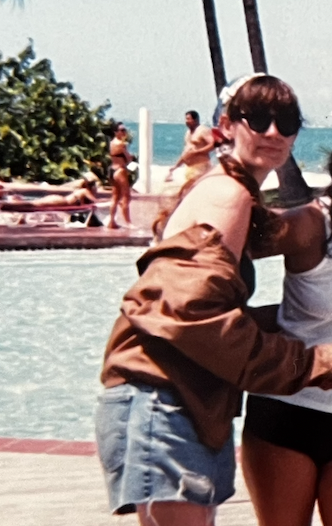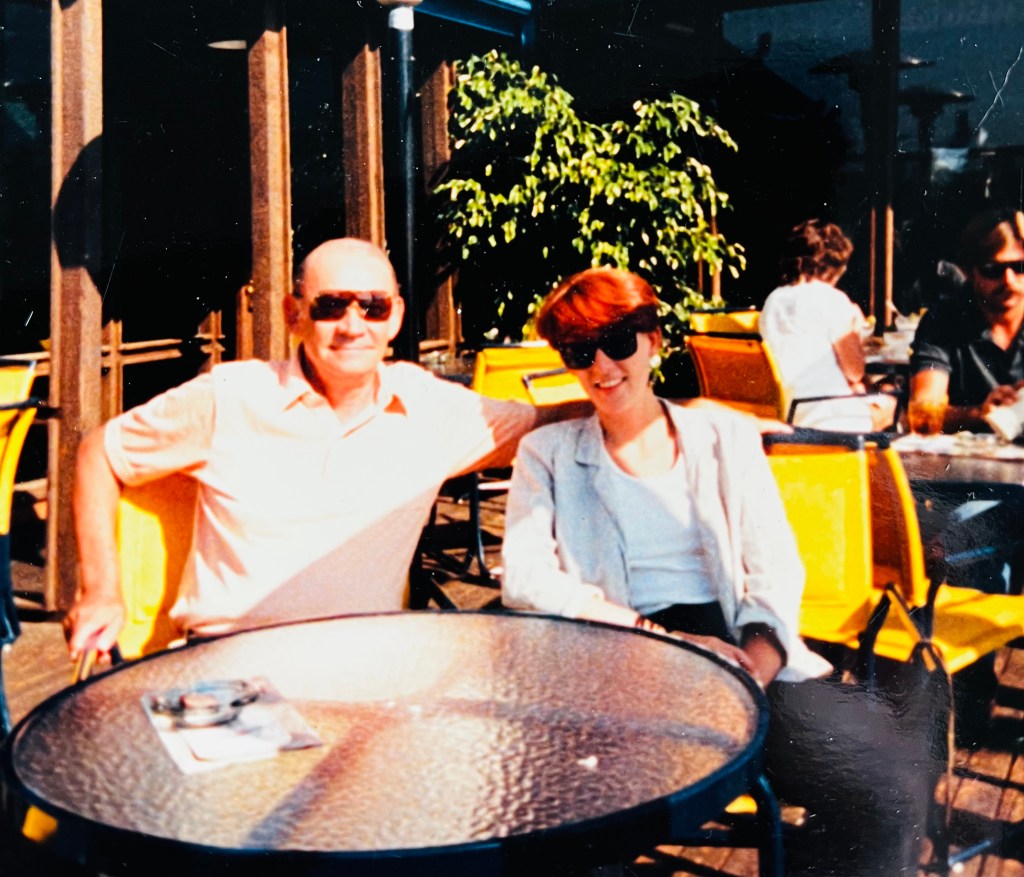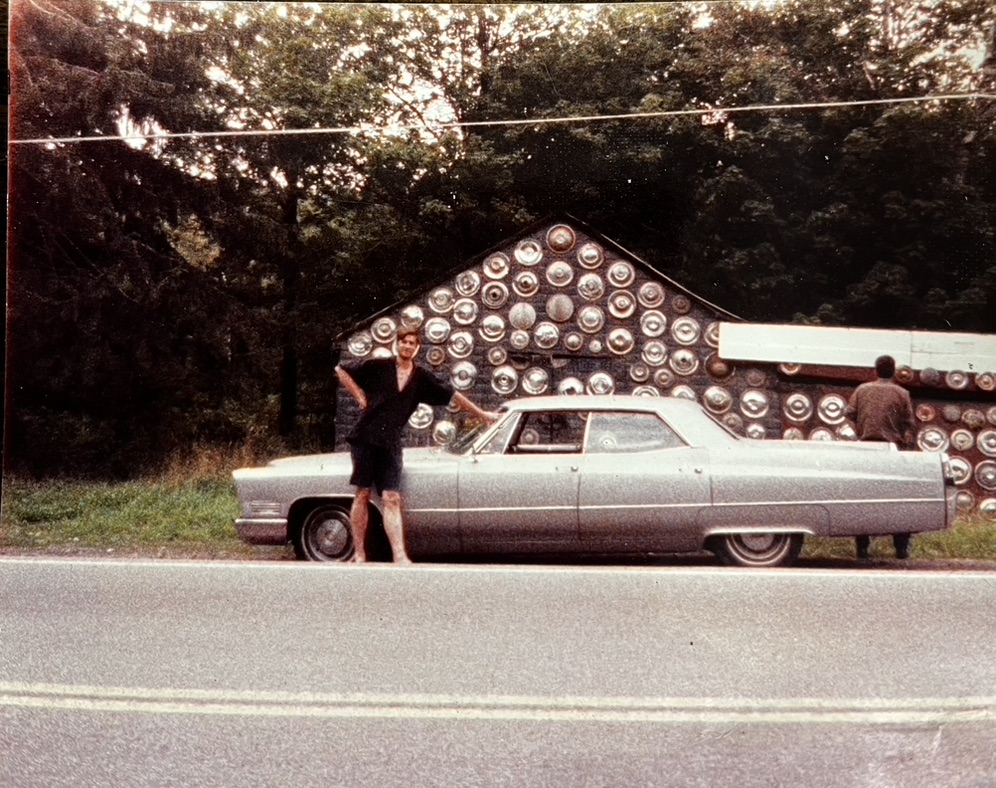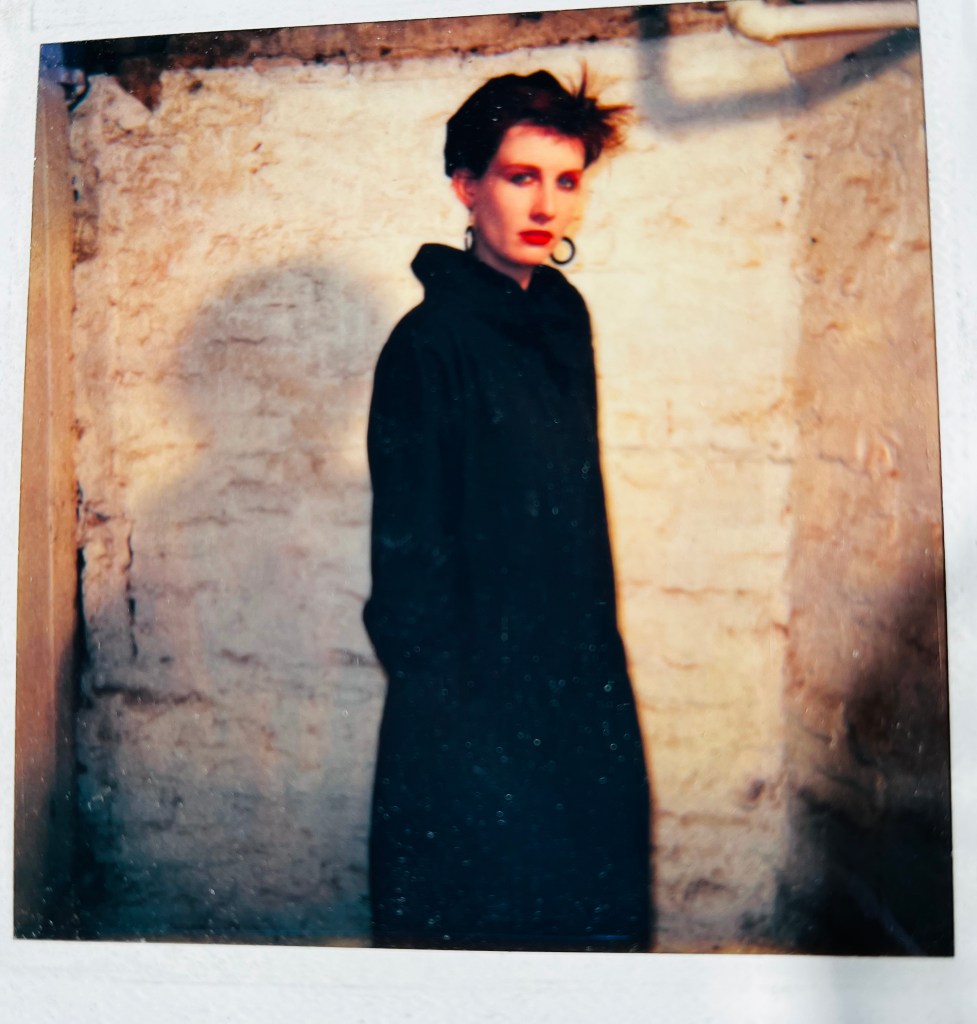
Hustling: the Elevensies

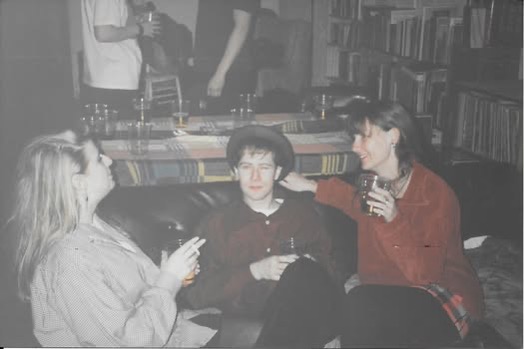
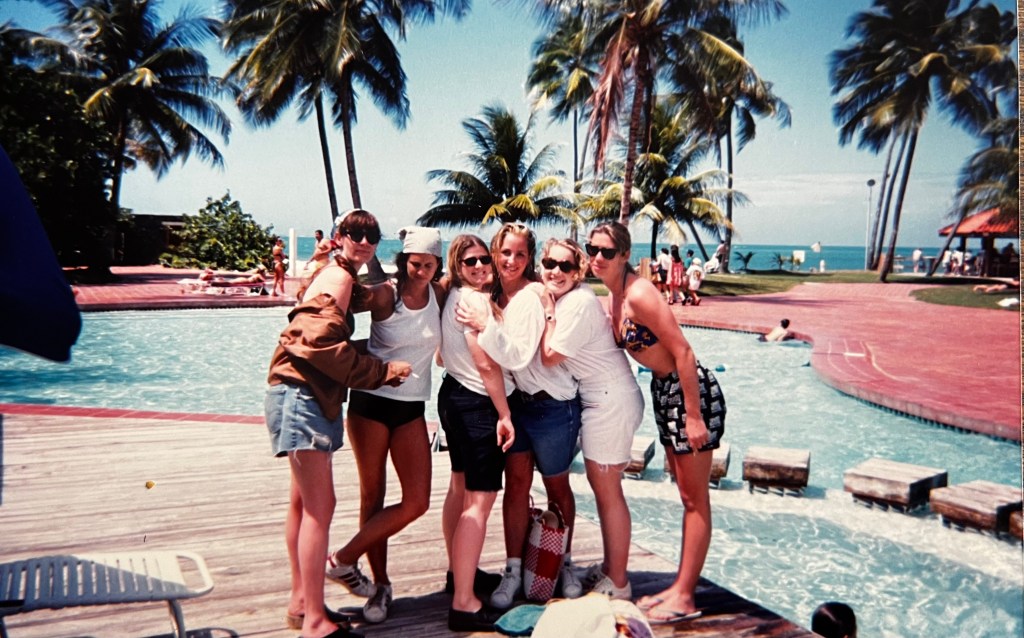
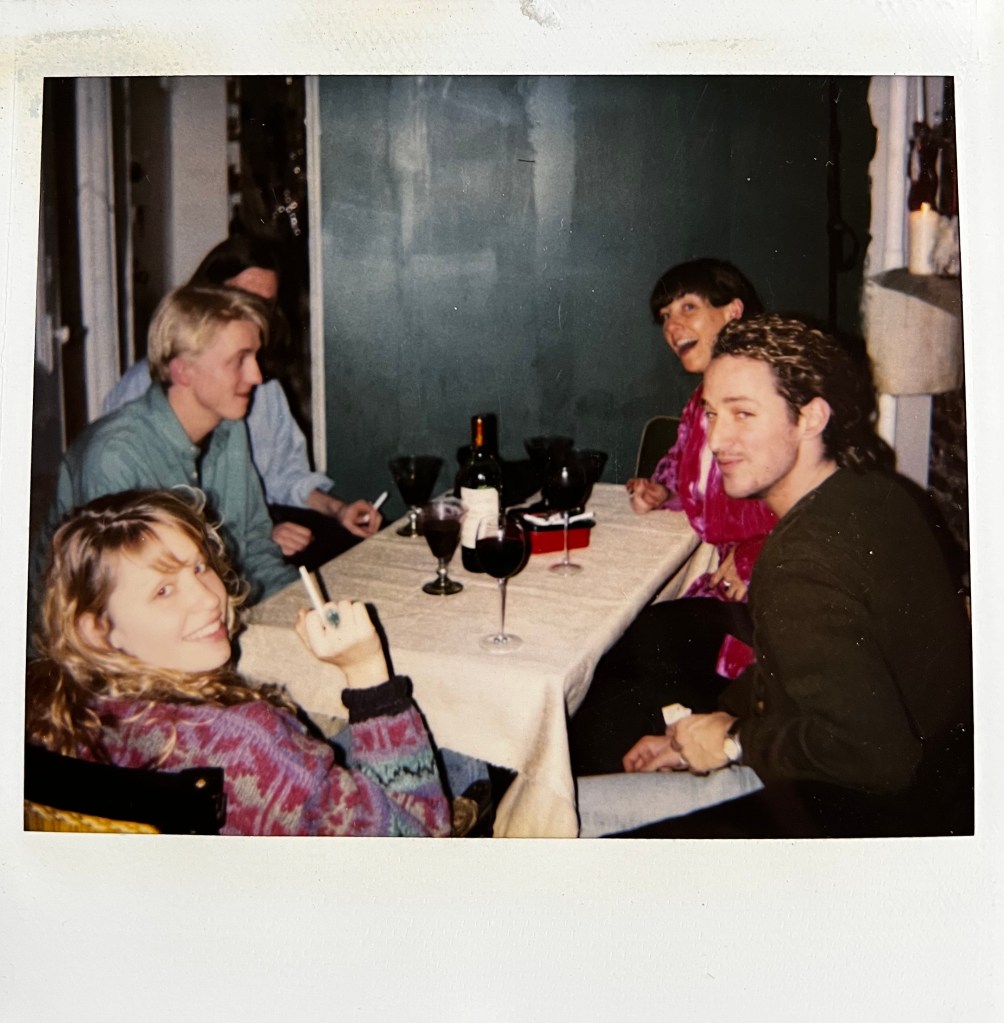
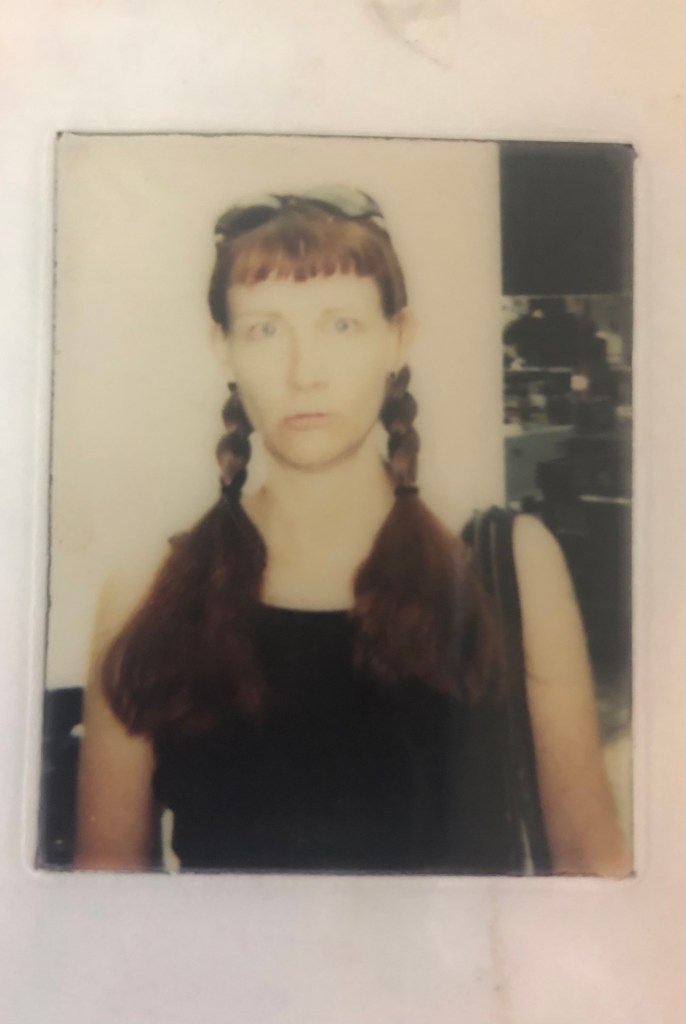
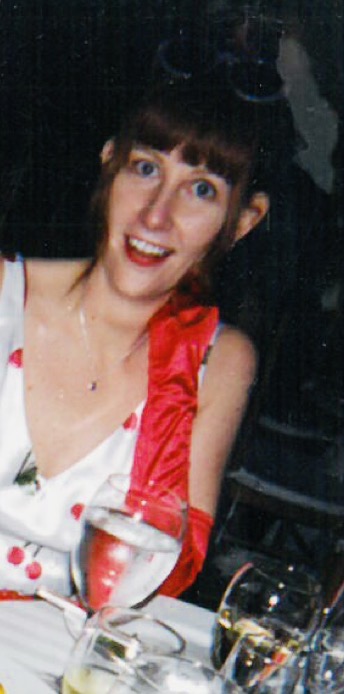
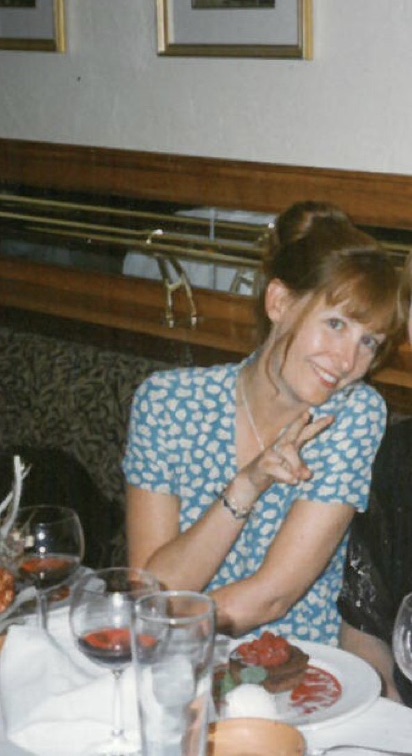
That final summer living in the 12th St. alcove apartment was a split reality. I’d look in my closet and see the bounty I’d bought during my retail therapy dayz. I’d look in my bank account and see the diminishing monies given I didn’t have a fancy job anymore. I’d feel panicked staring at all the stuff smushed on hangers, or stuffed in milk crates, or crammed into the drawers and wonder if I’d ever wear any of it again. Back then there was no RealReal or Poshmark where I could think about selling some stuff. Instead I’d shut the closet door and pretend there was no problem. Rolling through my photos, I look at the ones above, and can drop immediately into where I was when I bought and wore those dresses. The two on the left were taken at a good friend’s wedding, which naturally became an occasion to go to Cynthia Rowley’s boutique in SoHo and buy something. Specifically, a dress with bright red cherries that, even at the time of purchase when I still had the hot-sh*t job, was a pretty steep, shiny-penny price. And the dress on the right was a wrap number that I bought at a street fair—you know the ones that take up a whole city block and mostly sell tube socks and fell-off-the-truck Chanel makeup. I lurved that dress so much that I was tempted (&tried) to go find the booth and buy it in every color, but I never could find that vendor again. My closet was the place that pitched me back into the memories of the numbed-out record company life. It wasn’t all grim. I remember vividly friends and laughter. It was more that I was confused about where I would land. I felt the map pinpointing my next location may have gotten lost in the mail yet the reality: I wasn’t at all sure what I wanted. I knew what I didn’t want but that didn’t feel like any sort of starting point.

I was most definitely at a crossroads as my thirties tipped toward my forties. Two secrets I held: I wasn’t feeling music anymore and I was broke. At a Christmas party in 1997, I met the guy who I’d go on to use as a human shield between me and my actual desires. Although obviously, I wasn’t self-aware enough to recognize that’s what I was doing. I still felt the writing muse swirling inside me, I just wasn’t sure how to let the genie out of the bottle. When Jancee called again from Rolling Stone with an assignment to review Marilyn Manson’s show in New York, I couldn’t find a yes. I tortured the pause between her, “So how does that sound?” and my grasping answer until she finally said, “Lauren, it’s me, Jancee. You don’t have to say yes.” So I didn’t. I begged off with some excuse, no hint of the truth that there was a pregnancy test sitting on my bathroom counter that told me something I wasn’t prepared for and didn’t want. Having a child was not a path I’d ever wanted to travel in my life and I’d made sure that this guy was fine with that, which he said he was. Until I told him the reality sitting on the counter and he began to play the devil’s advocate (“Perhaps the condom breaking is a sign.” “Yeah, no, the condom breaking is a malfunction.”) I wasn’t actually conflicted about my No decision though, nor did I feel sad or bad about making it. The view I have now all these decades later shows me that although I was hella confused about what I wanted to do with my life at that point, I was listening clearly to the voice inside that knew it would be a mistake to have a child.

I started therapy. Well, let’s say I went and yabbered at a lovely lady for an hour a week and called it therapy because in truth I hadn’t gotten the memo that to really do the work of healing, I’d need to listen rather than just talk. I mean, honestly, I wasn’t totally sure what I was actually listening for. The question of “so, what brings you here?” threw me into a total panic. What was I there for? The fact that I was crying all the time? That I had a vague sense of wrongness about my life? But really, was it all that bad? Life’s not perfect, let’s just ignore the nagging sense of being perpetually lost. Sitting in a chair across from the woman, I was convinced that if any sort of strength was going to be required to do this therapy thing, well, I wasn’t really feeling up for it. Before every session, I’d meticulously plan the script for what we would talk about, not in a vague way like, “I don’t know, I remember when my mother [fill in blank]” because of course the starting point is always about one’s mother (or father, depending) as it absolutely needs to be, which makes all the sense. No, I would literally craft a story around what I wanted talk about very specifically, then imagine the responses she might have and how I’d nod sagely and what I might say in agreement (I wanted to impress her with my self-reflection and openness. MiLord, you’d think I was auditioning for my own life, which, now that I reflect on it, I was). To her credit, she engaged me in a lot of viewpoints and suggestions that were helpful or would have been if I’d taken them seriously enough to dig in and be curious about them. But I didn’t do that. The deep dive required made me exhausted, or rather, terrified, which is always a sign you’re on the right track, yet…. I avoided subjects that might uncork any deeper-than-mom issues: Nothing about my relationship with the guy. How it didn’t feel emotionally or physically satisfying. The abortion never came up. I really just cried a lot. I’ve no doubt she was frustrated and also incredibly empathetic as she handed me the tissue box and I waved my hand around saying, I don’t know, I just don’t know, then shut down. I just couldn’t get beyond my own fear in order to pick up any tools to use toward self-awareness. And also, what if she told me the guy was all wrong for me, that what I was doing in my life was a mistake? I now know with absolute certainty having spent years with an aces analyst, that therapy doesn’t involve absolutes. It’s choices and perspectives and a good amount of tough yet ultimately relieving investigations into my life choices and circumstances. Literally no right or wrong just acknowledging happy, cringy, and what-was-I-thinking? moments for me to sort out with some wise non-judgy perspective. But back then, I had zero clue and 100% trepidation about exposing myself. The prevailing thought was that I could put down my head, close my eyes, and push through it to the other side where all would be better and forgotten.

In the end, I lasted with that therapist for about a year, then I called it quits right about the time the guy and I moved to Park Slope, thereby leaving my solo Manhattan chronicles behind.

Next week: How a relocation one borough over can feel like an eerie erasure of a whole chunk of one’s life.
Hustling (10-er)

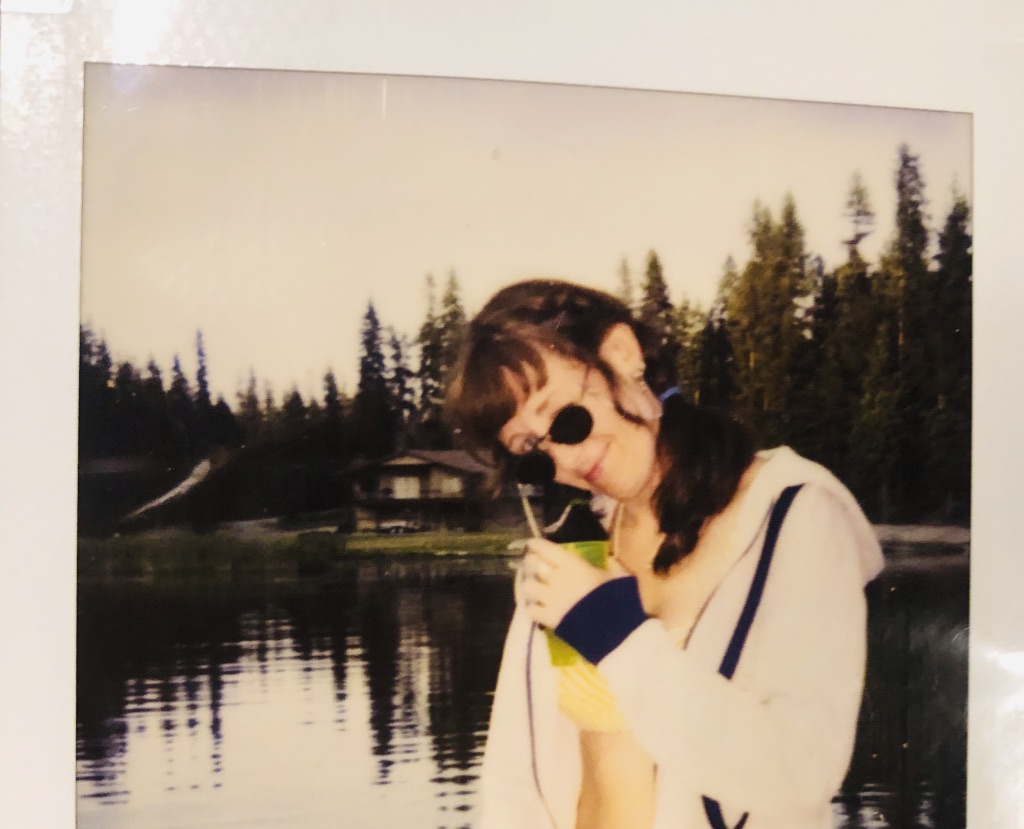
on a lake somewhere in 1997

Right before I met the guy who I’d decide was the escape hatch from a life I didn’t know how to live anymore, a couple of last-gasp moments in my music life happened. Having left the high-paying record company job to wait for what might come next, I sat in the apartment I couldn’t afford anymore and tried to look for next-step signposts. I suppose the keyword in that previous sentence is wait because I was nervous around the seeking. I still considered myself a writer even if my brain or psyche or whatever part of you it is that revels in planting seeds of doubt whispered otherwise. And while I was well aware that every month I was inching closer to financial disaster, what with my income primarily based on a plundered 401K and maxed-out credit cards, I was crap-ass at pitching story ideas to editors in order to get an assignment that would pay my bills. So I did what any self-respecting person avoiding reality would do: I went to the Union Square Barnes&Noble every day and worked on a modernized take on Peter Pan. I wasn’t in therapy at the time, but if I had been, no doubt the conversation would have included some drill-down into my “don’t want to grow up” “suspended in time” moments. I had no mythical Wendy to mother me back into emotional or financial health. I was in my late thirties and felt 100% shame around being a financial failure and confused careerist.

A couple of people did reach out with assignments, which not only helped bring in some money but also shone some light on where my career might be headed. I was asked to write a piece for the premiere issue of Jane magazine for a column called “It Happened to Me.” The article was my first-hand experience testifying for the prosecution at the SPIN/Bob Guccione Jr. trial and my editor, the awesome Bill Van Parys, was a great taskmaster, sending me back to the article over and over again until I brought the vulnerability that was needed to deliver the emotion of the story. The process was painful and also necessary. It was how editors work to bring out the best in a writer and it made me realize that as an editor at SPIN, I hadn’t often held my writers to the same rigor. Being conflict-averse did not lend itself to being a stellar editor, and that led me to crossing editor off my what-I-want-to-do-next list. I still felt a buzz around the writer’s life.

The issue with being a freelance writer though, was that I’d need to always be pitching. I’d have to come up with ideas that would then need to be sold (in theory) to an editor in order to be sold (for money) after they were written and published. The idea of contacting editors and pitching my ideas made me emotionally (&sometimes physically) nauseous. Terrified. In search of a small dark closet to hide in because somewhere along the way I’d decided I didn’t have any good ideas. This wasn’t just an I suck self-sabotage position. It was based on the larger elephant in the room. The one that had “I do not like music anymore” painted on its side. I’d had tons of ideas about bands and artists when I’d loved music but now I had zero interest in finding out what was new. I had no desire to ring up bands I’d known before to see what I could further wring from their life. The place in me that had been filled with the zing and seismic shake of songs, sweat, bombastic, slithery, soundscapes of chords and lyrics all mashed together felt empty, murky, not inviting at all. Yet I kept that a secret too.

My last Rolling Stone moment 1997

When my old pal Jancee Dunn, who at that time was an editor at Rolling Stone, called in the early summer of 1997 and asked if I’d do a Q&A with David Grohl, I was thrilled because that was fun and like home. But by the time I went out on the road with the band Bush in July for a small book of tour polaroids and anecdotes during the band’s Razorblade Suitcase tour, I was starting to cross over from the Lauren I’d been and the one I was struggling to meet. Looking back, I call up how isolated I felt. Awkward, not in any way a part of the scene. The band wasn’t friendly, although they weren’t decisively unfriendly either. The crew were the ones I felt drawn to for conversation because the support staff is always the more human element of these tours and it was too bad I couldn’t shift the topic of the book to them. (Sidenote: If you can ever find Cameron Crowe’s one-season TV show Roadies, you’ll see why.)

By the time the book was published in August of 1999, so much in my life had changed: I remember unboxing those Bush on the Road books in Brooklyn and looking back on the year-plus since I’d been on that tour and feeling as if that span had been lived by someone else. I can trace 1998 as a kind of personal scavenger hunt toward an escape hatch. Next week, I’ll invite you to trip along the trail as we relive that summer in the 12th Street apartment, my final 1990s New York City–space, before the Brooklyn period and married life began.

Hustling (Nine?)

Pals (Courtesy Danny Clinch 1996)

At the time in 1996 when my cat and I moved into the alcove studio on the corner of 12th Street and Fourth Avenue that I was subletting, I’d recently begun a high-paying job at Elektra Records as head of their video promotion department. It was an odd fit, putting me squarely into the corporate side of the music business. Somehow I’d decided that working for a music magazine was not a corporate gig, and while that might have been true to the extent that I could pitch a story and write about an artist without too much outside influence, if you lifted the veil at SPIN even a little, you’d witness the dealmaking between the record companies and the magazine. Especially when it came to travel. Writers would go on junkets, trips that were set up by the record company to promote one of their artists or bands where everything would be paid for with the unspoken rule that the journalist would pen a good story, which in turn would promote the newest release of said artist, and on and on. All magazines were approached by publicists to do these types of stories. Some agreed and others refused. Rolling Stone did not accept junkets for their writers. SPIN did. In fact, that was about the only way we ever traveled for an assignment.

Working at Elektra, I immediately understood how my participation in music had shifted. Whereas before I was a joyful participant and observer in the sound and the fury of the music business— snickering along with the musicians about some corporate shill who was trying mighty hard to go with the flow in a tiny sweaty club—now I was the shill. I’d been hired because of my relationships with musicians and my ability to walk in and connect with them. But along with my career change came a subtle shift in my perspective. I felt it first on an assignment where I needed to position a certain band on a popular music television program. I approached said band as I normally would: loose and jolly. I was met with a chill and an expectation that I needed to make sure I was fulfilling their expectations, which ranged from what they wanted in the backstage greenroom to when the corporate car would pick them up at the end of the day. Unlike at SPIN, they didn’t need to impress me so I’d write a good story, instead it needed to be impressed upon me that my job was to get them seen by the right people.

This shift in perspective drove a pretty solid stake through my music-loving heart. Kurt Cobain had died a few months into this new job, and I was really scrambling to keep my passion for new music aflame. Not to mention, I was tasked with working only with the artists that were on the label. I wasn’t actually involved in finding new music to cover. It went a long way that Elektra had some good bands that I loved: The Afghan Whigs, The Breeders, Metallica, Busta Rhymes, Bjork, and Ween above all. Still and all, my soul was dying a little each working day and night. I’d come home to my doorman building, take the elevator up to my third-floor alcove studio, make some dinner, turn on the TV, and zone out completely. I was taking a break from boys, from intimacy, and, apparently, from my emotions because when I think back on that time, it all feels a bit numb.

Which is probably why on the weekends, I would go up to the outdoor flea market that used to be on 23rd and Sixth Avenue and buy things (a weird art print that caught my eye and ended up in my closet facing the wall, a too-large fringed suede jacket that I maybe wore once, a purse the size of a pincushion that was covered in sequins … I mean, for anyone who knows me, I’m not nor have ever been a purse-carrying gal. Sling bags, yes, very tiny purses, no, especially when I was still smoking and carrying a wallet and keys and, well … not a tiny purse. But all this was emblematic of how I’d spend money to numb out. I know it has a name: retail therapy yet at the time that phrase didn’t land with me. By the time I’d get back to the building, the doorman would be sprinting to help me carry my many bags stuffed with stuff along with some too-expensive candle and bottle of wine that I’d drink myself along with takeout.

And about those candles: One day the owner of the apartment, who also lived in the building, knocked on the door and scolded me. That was because I’d regularly put one in the front window that faced Fourth Avenue, light it, then leave to meet the ladies mentioned last week at some place like the Odeon or Nobu where I’d spend the rest of that week’s paycheck. Rinse and repeat for all the weeks to come until I realized how utterly miserable I was. It took two-and-a-bit years for me to understand what was happening to my soul/spirit. By that time, the people who’d hired me at the record company and who’d really been my only reason for wanting to be there had been let go and there was a whole new shelf of people at the top who I reported to. I didn’t care for them and ended up sabotaging myself in a few different ways. Being quite crappy at confrontation, my biggest stumble came when I pretended that a certain hip-hop video had gotten placement on MTV when it hadn’t. Naturally, this led to a domino effect of shame when, in the weekly meeting, I was forced to admit that no, actually, the video hadn’t been added and what I’d meant to say was it probably would be … soon? I was then called to the chairman of the label’s office to answer for my lie. I went home that night, took off the sheath dress (gray, light wool, leather trim) that I’d bought at a boutique in Soho that weekend, balled it up, and threw it in the corner of my closet. I’d never be able to wear it again. Even months later, putting it in a giveaway bag for the Salvation Army transported me immediately to the moment in her office where she didn’t fire me, but rather yelled and yelled as I prickled with shame. Obviously I wanted to be fired. (Sense a trend here? Take a beloved car=break up with me; lie at work=fire me.)

I still had some amount of months on my contract, and when those months were done, I turned down a new deal and stepped out of the revolving door onto Rockefeller Plaza and sweet freedom. It was September 1997. Fall in New York City. Still hot but with the every-once-in-a-while crisp breeze that promised fall. A new beginning. I was ecstatic. I signed up for a writing class at the New School deciding I would find that creative muscle again. I would spin stories and spend time scribbling them down. I would worry about how to make money later. I would find my love for music again.

As it turned out: I did write, I didn’t make money, and I couldn’t find the music. I was 37 and not altogether sure what my career was anymore. Having stepped off music journalism’s path, I’d lost some ability to hear the piper. In fact, I wasn’t even trying to listen that hard. I did absolutely find bliss in not being told who to listen to and what to promote and I reveled in that freedom even if I wasn’t seeking out any new sounds. I still went out with the same group of ladies but always had a good reason to go home early since I didn’t have a paycheck and therefore no money to spend on dinner, clubs, and the rest. I was living on credit cards and a plundered 401K, a nasty combination that I would continue to work toward correcting for years and years. And when the holidays rolled around, I discovered that doormen generally like to be tipped in cash. Something I didn’t really have. So I baked mini banana breads and gave them out in bright little boxes. As I remember it, they were all gracious in taking my homemade offering, but it wasn’t lost on me that I’d soon need to move because even if I’d sold all those clothes that still had tags on them, it wouldn’t be enough to pay my rent for much longer

As it happened, the end of 1998 found me in a relationship that I, with equal measure subconscious calculation and determined escapism, used as a getaway vehicle from my go-go nineties, tripping-the-light-fantastic lifestyle. I jumped aboard and ended up in Brooklyn a long way from home physically and emotionally.

Hustling (the Eighth)

Hanging out in the ’90s: MTV’s Amy F.; SPIN writer and ex-Orange Juice drummer, Steven D.; and me. (Photo courtesy Fred Macintyre)

My 14th St. place was where I really stepped into my identity as a writer, although if you’d asked me then (and even on certain days now) to own that, to actually say, “I’m a writer,” I’d have dissembled and aw-shucks-ed my way through the admission. Somehow I thought I’d fallen into the writer/editor position at SPIN through some weird tear in the universe when no one was paying attention. That it was a quirk I happened to be interviewing The Cure, Pearl Jam, Nirvana, and the dozens upon dozens of other musicians who rolled through my orbit as I, with tape recorder and pen/pad in hand, watched, listened, and wrote about them. In reality, the job was hard work and had happened because I’d been single-minded about getting it. I realize now that just because something is a dream and it comes true doesn’t mean you a) don’t deserve it and/or b) will always feel dreamy—I mean, dreams can get pretty dark. Overall during my almost four years at SPIN, I’d step out of my 14th St. place with my headphones on and my schedule packed with music, travel, and interviews, and head to the SPIN offices feeling my power and thinking, Hell, yeah, this is me. I could hold that attitude for pretty long time.

What usually threw me off was stepping off the elevator into a tornado of guy ego-energy blowing through hallways. If I’d been able to see then the cock-walking and the bull-snorting for what it was: the aggressive territory marking of humans just as insecure as I was, I would have probably been able to sail through to my office entertained rather than intimidated, but I didn’t have that insight then. Instead, I’d fall for it, thinking, These guys are so much more music journalist than me. Just listen to them wax on about B-sides and the lost recordings of basement tapes that decipher the early sounds of R.E.M. and Metallica.

Luckily around that time, a group of kick-ass women entered my life who reminded me what feminine get-shit-done-with-integrity-and-fun looked like in that maelstrom of male music egos.

Girl trip

When I moved to NYC, two great friends had also moved from Cali within a year of my arrival, and we were still incredibly tight, but the women I met in the music industry were a different sort of magic carpet ride—one that I needed to pull me along in both my career and my personal life. Even as the atmosphere at SPIN became more and more toxic with predation and stress, I was finding I could feel my power in these friendships. There were certainly times when I’d wonder what they saw in me given I didn’t think I held the same status in the music biz, but looking back, I realize my perspective was smudged by my own self-doubt. These ladies and I weren’t the same sort of close that I had with my two friends from Cali. Although we confided in each other about a lot of things, there wasn’t a deep level of secret-sharing. To me the relationship felt more like a ride-a-long into some deep space music adventure. Each of us with a role to play: There were the two tough-ass music managers who wrangled tetchy personalities into submission, the two MTV executives who called a lot of the shots around what videos would get rotations and which bands would get airtime, the music-PR lady who knew exactly how to fashion a campaign around an up&comer or a been-around-the-block-too-much artist. Then there was me: The scribe. My role, metaphorically, to climb through the windows of a musician’s psyche, watching them work and recording their life. These ladies were the ones who built the house whose windows I accessed. They decided what color the walls would be and how the whole operation might look to the wider world. But also, I was lucky enough to be given access to creative sorts who would let me into places where today the structure of PR, managers, and company executives would never let a writer go.

It was a heady time, even if in some corner of my mind I felt there was an expiration date to the whole adventure. Coming back to my apartment to a voice machine filled with bill collectors reminded me that my orbit had much less financial oxygen. My salary didn’t even come close to theirs, but they never knew that since money was my shame point and so I wouldn’t have admitted I couldn’t afford the dinners, trips, shopping moments. I’d slap down my credit card with the rest of them for a flight to some palm-tree place, then turn down the volume of worry around how I would pay the bill. At that point in my life, I felt everything would be taken care of in the future. Right now I was doing this, spending that, following my desires. Perhaps, if you’d questioned me back then, I might have asked: What’s the problem? I’m living in the moment. But that Buddha-mindset was not zen-based, it was avoidance-driven. I did have an inkling it would all come crashing down though.

And of course, it did. Four years in, at the tail end of my 14th St. stay, I walked (ran) out of SPIN feeling like I wanted to peel off my skin even though I didn’t spend any time (at the time) to figure out where this sensation came from. I stepped into the land of talent booker at Jane Pratt’s TV show where I was a contractor (read: no more health insurance) and where the pay was even less. But I didn’t care. When that ended six months later, I collected unemployment, did some freelance writing, joined up with a couple of people to rep video directors, then landed a stupidly high-paying job at Elektra Records as the VP of video promotion. This would prove to be absolutely disastrous to my creativity and love of music, even though I’ll always be incredibly grateful to my dear friend J for getting me the position since it gave me a rest from money woes.

Never one to just build a savings account, I decided to move with the cat to a doorman building near Union Square so I could continue to spend more than I should have in order to be a part of New York City’s movin’-on-up set. Next week: reasons why doormen and burning candles (not necessarily at the same time) lead to awkward interactions and how to defer depression with retail therapy.

Hustling (Lucky Number Seven)

14th street: Good friends on a holiday way way back in the time machine

The place on 14th street between Avenues B&C was my first solo adulting apartment. A railroad one-bedroom with no doors except for the bathroom, which was only a toilet and sink because the shower was in the kitchen. The front door let you into a large kitchen, then you passed through into the dining room/living room space and on through to the bedroom at the front, which faced 14th street. All the windows except for the two in the bedroom faced an airshaft. A dear friend of mine lived in the building across the way, so if I looked out my kitchen window and saw her light on I knew she was home. If either of us saw that light and were, say, watching Twin Peaks, we might call each other and watch together. This was waaayyy before streaming so you needed to catch the moment as it happened.

One of the two windows in my bedroom that faced 14th street had a fire escape, although I didn’t spend any time on it as I had in my former apartments because this was the place where my life became very busy. I’d been at SPIN for a solid few months and though I was finding my footing to some degree, I also felt like I was walking on ice in six-inch stilettos. And I’m lousy with heels so my equilibrium was constantly off balance. Yet I masked that as one does when one feels they are in the place they’ve always dreamed of being yet somehow the colors are much different than what they expected. Still, I can call up inside me quite clearly the thrill I had getting up each morning, getting dressed in my thrift store finds (favorites: an orange pleather mini skirt that snapped up the front with a striped black-and-white shirt whose sleeves were overly long; a black-and-white, polka-dot circle skirt, short with a wide elastic waist and a men’s black crew-neck sweater; a blue-and-white striped on top, solid blue on the bottom, long-sleeved mini dress. All of these worn with leggings, motorcycle boots, and a wrist-full of silver chains and plastic o-rings (à la Madonna). I’d put my hair in two braids (sometimes four), put my headphones on, and slip my Walkman in my pocket, being careful not to get tangled in the cord, then step out the door filled with an energy of what today’s rock’n’roll moment might hold. I no doubt had a slight hangover.

Varying levels of bangs throughout the 90s from straight precision (left) to too-short self-trimming (above), and vision-obscuring long, all with two-to-four braids.

This heady feeling of me in 1991 was due to it being the year I came into my sense of creative power. I’d leave the building, cross 14th Street and walk through Stuytown and Peter Cooper Village, a sprawling multi-block living complex that stretched from 14th to 23rd Street complete with green grass and fountains. (Side note: It’s worth reading about here given the history is rich in how NYC developed affordable housing post-WWII and still—to some degree—supports that mission.) I’d exit at 18th Street and head crosstown, over Avenues First, Second, Third, Lexington, Park, then cross Fifth Ave. and halfway up the block on the left were the SPIN offices. Throughout the walk I’d be listening to whatever advance tape had caught my attention or that I needed to review, so that at any given time Soundgarden, Hole, Babes in Toyland, Ween, Metallica Smashing Pumpkins, Girls Against Boys, Beastie Boys would fill my noggin, although the Nirvana and Pearl Jam releases were the most spun and auto-reversed. Maybe I’d stop for a greasy egg-on-a-roll and milky coffee in a We’re-Happy-to-Serve-You cup from the diner or yellow rice-black-beans with an egg and white bread cut on the bias, toasted and dripping with butter from the Dominican place under our offices. Then I’d head upstairs, say hello to our wonderful receptionist (she really was so much more than that though) and go into my tiny closet-sized office.

And so it went for many years: I’d step through the looking glass each morning, then be dropped back into my 14th street apartment after all the events of the day-into-night were done. I knew I was coming into my fullest self, yet there was so much I was pretending. The duality of me out in the world stomping around in my kick-ass boots, then coming home and making dinner (when I had a night to myself) that I’d put on a plate and serve to myself at my tiny dining room table were two halves of a whole. On the fated Christmas where I lit the tiny eucalyptus bough on fire (too close to the candles) and served veal to the vegetarian, I had been so filled with happiness to make and present a meal to all of us holiday-away-from-bio-family friends that I went a bit nuts going to the butcher, the baker, the candlestick maker (well, maybe not that last one) and created a multi-course feast. Although you can’t see the food in the photo above, the wine, cigarettes, and happy moments are there.

This would be the place I’d live for a lot of years. Where I’d sit in the dark as bill collectors left messages on my machine and I’d feel faintly scared trying to decide if I was a rebel or just a very broke girl, where I’d be gifted a little wee cat who I’d be convinced had disappeared into a hole in the apartment’s wall after I got her and then didn’t see her for a few days (she did eventually come out and be with me for 20 years). The place I felt my first true heartbreak and heady passion. But that’s to come.

Hustling (and the Six)

Red lipstick, Miller hi-life, the beginning of SPINning, interviewing bands, and learning how to live on my own.

Although I’m sure I can’t be trusted with pinpointing exact dates or even locations (months, years, NYC blocks, and what-have-you), 1989-ish saw two major transitions happen in my life: a move to a studio apartment on 4th St. between Avenues A&B and a job switch from Rolling Stone to SPIN magazine. The first shift happened a few months after the events described in last week’s entry where I described my fail in dealing with and facing the end of my relationship with my roommate. And while his Cadillac was not harmed in the process, my hope that he’d break up with me because of my actions did not happen. I had to be the one to face the facts and make the move.

Many a NYC dweller has described staying in a relationship that should have ended months (years) earlier because real estate in the city was/is so brutal. See Tama Janowitz’s Slaves of New York. But I knew that staying in the apartment on Stanton Street and just retreating back to my original bedroom was not going to be good for anyone so I grabbed the Village Voice every Thursday and combed the real estate listings as quickly as possible given the cutthroat nature of finding, then securing, the first good (or even halfway-acceptable) thing you could find. This was waaaayyy before the internet made looking at apartment listings—complete with photos and semi-correct information—something you could do from literally anywhere. Instead, it went a little like this: Get your pen, circle the possibilities fast, pick up the phone and start dialing, then be willing to show up immediately with a check, ready to give the landlord every bit of your money. An alternative to that was reading the obits, then turning up at the building of the recently departed and ringing the super’s bell. In all of my apartment searches and gets, I’ve been able to work the former example with the most success. So in 1989-ish, I walked the streets around the East Village, which was still within my price range and a neighborhood I knew and loved since it was the only place I’d lived in the city. My Walkman headphones blasted Iggy Pop as I’d turn up at each available rental hoping the place wasn’t too depressing and prepared to hand over first and last month’s rent along with a security deposit. I’ve no doubt I had to borrow this large chunk of money from one of my parents given a savings account was something I’d heard about but never met in real life and my salary was barely there. The possibility of a rental scam was also always on my mind. One especially insidious situation was a super asking for a “key fee,” which basically meant if you gave him/her some cash on the spot, they’d make sure you got the apartment (you can read about it here if you’re curious about old-school real estate badlands).

Eventually, I found the cute 4th Street, third-floor studio, which looked out over a back garden, and grabbed it. Maybe there was an application to fill out? There was a lot of money to hand over, but, ultimately, I signed a year’s lease and got my own set of keys. Living on my own was an absolute joy. This was my first solo apartment ever. My entry into a part of adulthood that felt like a big breath into the future. I can remember a sense of freedom that I could come and go, say and do, decorate and make a mess in whatever way I wanted whenever I wanted. This would be the place where I set up a desk facing the two windows that overlooked the back garden by taking a piece of plywood, painting it black, and laying it over three stacked milk crates anchored on each side. I then put my typewriter in the center. One of the windows had a fire escape and I’d go sit out on it in almost all weather to stare at the back of the other buildings, trying to see in the windows while making up stories about the people who lived there. This particular window, which had no screen, was where a squirrel decided to enter one day. That squirrel apparently had designs on moving in given it was a nightmare involving a broom and a lot of yelling to finally get it out through my open front door, down the stairs, and out the apartment entryway. After that, I got a sliding screen for the window and sometimes I swear I’d see that squirrel flipping me off from the tree outside the window.

That window was also the location of my first break-in. I’d come home one night to find my front door cracked open, the lights on, the screen removed from the window, and my place rifled. As I remember it, I went from cold-sweat shock walking in, thinking how surreal that someone had been there—that is once I’d made sure they weren’t still somewhere in there, which took under five minutes given the size of the place—to a feeling of vague offense that nothing had been taken. My drawers were emptied, desk made a mess, and cabinets opened but that was all. My record albums had been pulled out but apparently nothing had appealed to these burgle-heads. When the police showed up, they seemed (were) bored by my story and told me the intruder was no doubt just looking for cash or valuable jewelry and while of course I was relieved on one level, it also felt like a reminder of just how little I had and how spare I was living. The one valuable cop tip was to make the landlord put a gate on the window, which never happened so I never felt safe again in the space. That was the true crime really: This apartment that held all the promise of my new independence also exposed the fissure of fear that came with being a single person in the city.

So while I would last out the lease, my next spot on 14th St. between Avenues A&B, found courtesy of a friend, would be a one-bedroom with a separate kitchen, albeit with the shower in it, a walk-in closet, although please know that “walk-in closet” is a loosely used term in NYC tenement building parlance meaning a small space with bi-level rods and a shelf. The apartment was a safer space and all mine, mine, mine. This would be the place where I’d live all through my SPIN years, learning how to ignore bill collector phone calls while developing a deeper more dependent relationship with the city. And also the place where I’d light a Christmas display on fire (by mistake) right before serving veal to a vegetarian friend (by mistake). But that’s all to come.

Hustling (a Fiver)

My dad and I during my college graduation week, although I look fairly fully adulted in this photo.

Before we time-machine our way back into the 80s, a note about how it’s not lost on me that pulling threads of stories from the past into the here&now is cloaking me with a bit of escapism. I’m appreciating it. That in no way suggests I’m immune to the daily (er, hourly) hits my emotional psyche is taking as we live during this bludgeoning of democratic norms and watch the cruelty that is hammering people down every street and around every corner of the world. The high tension has become a constant buzz in my head. I’m making my 5 calls and figuring out how to read (or listen to) the daily goings-on.

I’m taking these time-travels because, although there are moments I’d enjoy ostriching my head into the sand (a thing they don’t actually do, BTW), the stories remind me that even in the darkest of the Reagan years—the bulk of which I spent as a new arrival in NYC—along with the crises of my new home city’s epidemic of AIDS, crack, and an increasing population of unhoused folx, I can still access the joy and pain of my life back then. In fact, the darkest, most confused of those moments brings with it sharp contours of the beauty in succeeding where I could and did. If I can still find my way to tease out those moments currently, then I’ll try.

So let’s step into some of those way-back moments, shall we?

Last we saw that Cadillac, it was 1997, I was working at Rolling Stone. I’d graduated from SVA with my journalism degree and was having a relationship with someone I really shouldn’t have been having a relationship with. At that moment in time, it was occurring to me how wrong the relationship felt. When I say occurred, that might strike you as a conscious idea that pops fully formed into a brain and then is perhaps explored and acted upon. But that would be wrong in this case. For the purposes of my life at the time, occurred merely meant there was some itch at the base of my brain that made me think I was either in need of another shot of tequila or needed to turn up the music to drown out any semblance of thinking. Ideally doing both at the same time was a quick way to block out that itch. Up to that point, anything involving confrontation was outrageously uncomfortable, and therefore I went to absurd lengths to avoid it. While confrontation is still extremely hard for me, I’ve had a helluva lot more practice and at least realize that causing diversionary commotion (look over there at that exploding tree) while I run the other way and never return is a very unfortunate and damaging way to deal with situations. But back then? Meh … no concept of the extreme silliness and sadness that kind of avoidance brings.

So there I was, working my starter dream job at RS and developing a fierce crush on one of the other employees. He was in a band (natch) and had a girlfriend. I was very deadset on never sleeping with anyone who was involved with someone else, which seems cockamamie given I was currently sleeping with a person who was an ex of a former friend, but somehow I’d justified that because they’d broken up. My thinking around work-crush guy was that if I waited out his relationship by being his very good friend, then maybe someday. Rom-coms are very insidious and I’d seen/read too many. Oh, and also, I decided to become the manager of his band. This was, frankly, an insane move and why they said yes is mysterious. Maybe because I didn’t charge them any money. I’m not sure what they thought I’d achieve given I had zero connections to any club bookers at the time and I hated, despised, had real trouble conversing about business stuff. I’d offered because it would mean I’d spend more time with the band. Suffice to say, for the maybe two months I held this role, I never once booked them at a club. But I did hang out with them almost every night.

And now for the part where everything became much more stupid than it needed to be. The roommate and I were seemingly going along fine, at least that’s what he thought and I didn’t disabuse him of that. One night, when crush-boy’s band was playing at a local club (one that I didn’t book them in), I asked if I could borrow the Cadillac to help them move their stuff back to their rehearsal space after the show. He said yes, with conditions: You can only put stuff in the trunk; please don’t put anything in the backseat. Original upholstery, and all that. And also, please don’t leave the car unattended in Brooklyn. (Where the rehearsal space was. I mean, we lived in a crazy neighborhood but the Cadillac was parked in a gated/locked lot down the street away from sidewalk marauders.) OK, said I, knowing I would break at least a couple of his terms. He went to work at the bar, I went to the club with the wheels. The show was great, the set ended, the bar closed, the equipment was moved out onto the sidewalk, and, naturally, not all of it would fit in the trunk. I hadn’t even told them about the no-backseat rule, so they began to load the balance into the backseat. I’d put a towel down, but still. Everything was packed in tight and we headed off to Williamsburg, Brooklyn, which back in 1987-88 was still abandoned factories and empty streets but also upsurging spaces for artists and a fertile hip-hop scene, and where they lived.

We unloaded all the gear with no injury to the Caddie, which was a win that made me feel like now I could relax and have fun. We ended up at the singer’s apartment: a sixth-floor railroad layout that was only two rooms where we drank some things and smoked some stuff. I also shamelessly flirted with the bass player because somehow in my mind I’d decided that since I wouldn’t be able to be in a relationship with the guy I wanted to be with, I could get close by hanging with someone in the band. Relationship by proximity. Oh-mi-gawd all of this was so ill-conceived and current-day Lauren is actually cringing right now. But back then, meh, no thoughts. Night turned into morning. The Cadillac still out on the street in front of the building. Every hour or so I’d step to the window, open it up, and stare down at the thing shimmering in the moonlight, then the upcoming dawn. Phew. I was so proud I hadn’t hurt the car. But wait. I was still completely f&Ckd because it was now morning and I hadn’t called the roommate to say where I was and I had to now go home and face him. Here’s where avoidant-brain set in: Secretly I wanted to do something so bad that he would break up with me so I wouldn’t have to break up with him. See? Banana-pants self-destruction.

I finally got my sh&t together and drove home. I reparked the Caddie in the gated parking lot. I walked the walk of shame back to the apartment, let myself in, and on the table I saw the yellow pages open to hospitals (for those too young to know about phone books, they were giant paperbacks with yellow pages filled with all the phone numbers). The roommate was not there. I stood in the middle of the living room with the dawning realization of just how terrible a situation this was and how I’d manufactured it out of whole cloth all by myself. When the roommate did come back, I might have still been standing frozen in the middle of the floor. He was worried. He’d thought something terrible had happened because why would I intentionally keep the car out all night? Why would I not call him? I wasn’t that kind of person. But, see, I was that kind of person, I’d just kept it hidden from him. And now I had made him worried and sad and confused, not at all mad. And he didn’t break up with me.

I would have to figure out a way to do that on my own. And that part of the story, well, let’s just say that next week, when we visit my new apartment on 12th street between Avenue A and B, the place where I was burgled for the first time, you’ll find me a bit chastened.

Hustling (the Fourth)

Whose manuscript was I holding? Is that lint on my sweater? My love affair with striped shirts in full effect.

In 1987, I had been living on Stanton Street for a year+plus and slowly making my way into a future I could be excited about. A large part of my last semester at the School of Visual Arts was getting an internship. My first choice was SPIN magazine so I gave them a call. The woman who answered the phone told me that there weren’t any internships available at SPIN but that if I wanted, I could start an internship at Penthouse magazine, a few floors up. Then, because SPIN‘s owner Bob Guccione, Jr., was the son of Penthouse‘s majordomo, Bob Guccione, Sr., and they basically shared an HR department, I would be well-positioned to snag a SPIN position once one opened up. To be clear, in those days HR departments were basically the people who put you into the payroll system and made sure you knew where the bathrooms were. They supplied literally zero protection around things like harassment or bullying. I mean, this was publishing baby (or rather: porn and rock’n’roll).

Somehow this offer to come work for free at Penthouse while awaiting SPIN admission made sense to me. Foot in door and all that. A few things about Penthouse I observed in my first few days there: Bob came in one day a week to shoot the centerfold in a dark room (not a darkroom, but a room with close to nonexistent lighting) that was set up for only him to use; no one could go into that room while Bob was, er, working; Bob drank endless cans of Coca-Cola, which he was never at a loss for because his assistant followed him with a six-pack always in hand; Bob did not know how to use the buttons on his shirt given they were never ever in any universe utilized so that his bare fuzzy chest was always on display. Also, he walked around with a 35-mm camera around his neck, purportedly in case he needed to shoot a centerfold at a moment’s notice. The staff was mostly women and I was mostly baffled. A part of me would get very indignant about how women were being objectified and how could any of these women working for Bob put up with it. Then I was reminded that I was working there for free, my choice. Sometimes I would think, this is very freeing what these ladies are doing, choosing to make money by posing in this magazine. Basically, a chorus of voices would stake conflicting feminist stances that I really never squared during most of my music journalism career. There was a room where the Penthouse letters team held forth. Four guys and one woman sitting in a very small room with a door. They would take the letters sent in by readers (“I would like to meet Miss July. She is very sexy. Thank you, Johann.”) and turn them into little erotic stories (“I would like to ____ Miss July. She is a ____ piece of ____ and if I met her I would _____ and _____ and ____ and then ______. Yours, BigOleMan with a very large _______”). I came to see this as pure creative writing and suspect that most of the time, the only part of the senders letter used was the person’s name, city, and state.

At least once a week I would wander into SPIN‘s offices to loiter and angle for a job. I’d often be joined by folks who had just come up off the street. It was hard to tell whether they were rock sorts or people in need of food and shelter. After about two months, it became clear that the woman in HR was wrong. SPIN, I found out, didn’t have and weren’t at all interested in having any interns. Since Penthouse wasn’t even close to where I wanted to be career-wise, I sent a letter to Rolling Stone. It turned out they did have an internship program and if I wanted to be considered for the spring slot, I should come in for an interview. Which of course I did, then got the gig, then when the semester ended and the internship was meant to be up, I decided not to leave. I was graduating in June and made the executive decision that Rolling Stone would be my full-time employer wherein I could quit all my waitress jobs and begin my career. Amazingly, it kind of worked out like that.

I became executive editor Robert Wallace’s assistant, which meant understanding that when a man called and said he was the Doctor, he wasn’t actually Bob Wallace’s doctor but Hunter S Thompson. And when said Doctor turned up with beer and whisky, that I would know not to put anything in the refrigerator and instead open all the beers and the whisky and line one after the other up on Bob’s desk. These kinds of things along with transcribing interviews from writers such as Lynn Hirschberg were my main job until a spot opened up in the copy editing department. I relocated downstairs where the copy, research, and production departments were. It was also the floor that held the Capri Lounge, which was the photo developing/drug den. Jann had brought the photo development staff from San Francisco and they’d brought their stash, along with a very ratty couch. Anyone who wanted to smoke, snort, or otherwise alter their consciousness could swing through their revolving door. Above us, the Springsteens and Jaggers roamed, and below them, we would do the dirty work of making the writers’ stories resemble excellent prose. I loved the job, and naturally, the people I worked with became my family as happens in those career jobs when you’re starting to forge yourself. When I wasn’t at work though, I was still cultivating my life downtown on Stanton Street.

Soon after the broken dishes event mentioned in last week’s post, my roommate broke up with my friend, which was awkward given she wasn’t really 100% over him so I’d often find myself on the receiving end of pointed questions such as, “What’s he up to?” and “Does he have a new girlfriend?” I would punt these as best I could. But then I went and did something irreversible and damaging: The roommate and I began to fool around. While for well over a year we’d been cohabitating and hanging out as friends with no pull at all toward each other, one night after going to see Hüsker Dü at The Ritz (now known as Webster Hall), we found ourselves literally face to face and acting on impulse. While it doesn’t do any good for 2025 Lauren to pull out the judgment to crush 1997 me, of course in retrospect and through years of inner investigation and experience, I recognize the layers of emotional blindness I was acting on. The dirty little secret, the one that I couldn’t hear except for a little scratch at my consciousness, which I ignored by turning up the volume on the rest of my life, was that for a long while I’d been conflicted in my friendship with his ex, yet I didn’t have a clue how to deal with that. The thought of pulling away cleanly from—or even just set boundaries with—her was something I couldn’t figure out. So I let a situation happen with him that turned me (&he) into a villain. It was such an impulse move toward self-sabotage that I don’t even think integrity was a word I knew how to spell. I didn’t have the emotional language, I just knew somewhere in my lizard brain that if I did this thing with him, I would blow up the friendship irrevocably and that would take care of our uncomfortable friendship. I dropped a cherry bomb right into the friendship fireplace where it wiped everything out and took casualties. (I almost need to take a nap when I think back on the blind-logic and machinations in my head as I walked blithely into the fire without looking back.)

A great sadness I can feel about that action is how it affected a really good friend of mine. Someone dear to me who was friends with both of us. I know my actions set her up for a lot of conflict with this mutual friend. But, again, as I was stepping through that fiery entanglement door, I wasn’t thinking about any of that. While the roommate and I had an almost year-long relationship, I don’t think back on it as love. In fact, there’s a certain numbness around the whole thing that has a lot to do with just how disengaged I was from my emotions. Not to mention, I was thoroughly disinterested in exploring my motivations since that would require inner work. And just to bring home how ill-equipped I was to deal with uncomfortable emotions, next week’s post will dive into the cherry bomb I dropped into the roommate/lover situation—it involves the Cadillac.

I know I mentioned that the Cadillac would be a front-and-center this week, but since writing, at least for me, has everything to do with going where the story takes you, other things bubbled up here instead. I have bounced one into the sound file below if you’d like to hear about how this large boat-like vehicle became a target of discomfort on a trip across the Canadian border. Till next time, thanks for being here as I travel these memory roads.

Hustling the Third (Part 1)

The local EV bar

About three months into the Ninth St. sublet, the boyfriend of a good friend was moving into a place on the Lower East Side on Stanton between Norfolk and Suffolk. It was the whole floor of a building and he was looking for a roommate. After seeing it and finding out I could afford the rent, I signed on. It was multi-roomed and with two entrances, which meant I could enter my bedroom, get to the bathroom, kitchen, etc. without tromping through my roommate, A’s, bedroom. There was also a fire escape off my bedroom window, which I sat on to read or just stare at the activity on the street. The neighborhood was still gnarly (to hear one instance of how gnarly, listen to the sound clip below). There was a bodega to the right of our building which maybe didn’t really sell bodega-like items. I discovered this when, soon after moving, I went inside to buy eggs and the guy behind the counter just shook his head at me when I asked where they were. Basically there was no dairy product section at all. There were loads of dusty paper goods: towels, toilet paper, diapers; although none of those products seemed like they’d been moved or even considered for a while. Those things felt more like window display installations. They did sell loosies (single cigarettes) and probably other smokables (and snortables) that were kept behind (under?) the counter and had to be asked for.

Although the crack epidemic of the eighties was really taking hold and our neighborhood in particular seemed to be in the grip of it, I still felt invincible in that way you do when you’re young and choose tunnel vision over a full-spectrum view of your surroundings. In my case, I knew that if I turned left as I left our building, I’d absolutely pass by an abandoned building that had been taken over as a location for crack dealing and doing. So I only turned right, pretending nothing else existed except the Delancey Street F train station or the slammin’ rice&beans&cafe con leche hole-in-the-wall joints on Essex and Ludlow streets or Cantor’s up on Houston or the bars and Sidewalk Cafe on First Avenue. Overall I was proud to feel tough enough to live both in my new neighborhood and in the city. I was also happy to have my own room, a small space with a loft bed, which in the summer was hot as hell. I had a tiny little fan that only managed to move the humidity around. This all seemed extremely romantic. Suffering. So La Boheme.

Pool was played at that local dive bar

The suffering, as you’d imagine for a twenty-four-year-old, was filled with the melodrama of broken hearts and high drama that was painful in the most sentimental of ways. On some level, in between clutching my heart (or head if I had a hangover) and planning revenge (which was usually a very weak tea mixture of deciding what outfit would make him want me again and planning verbal zingers), I would think about storing up all the details for some fuzzy storybook. That was when I wasn’t crying or drinking or reading Paul Bowles out on the fire escape. That apartment was where I learned that the boy I’d first fallen for in NYC, the one mentioned in last week’s writing, was fooling around with someone else on the side. Another waitress at Dojo to whom he’d been teaching drums. Effin’ drummers. And I’d found out because friends from California had come out for a visit and were staying in his apartment when she left a pretty explicit message on his phone machine. Nothing can put a damper on your vacation like having to decide whether to tell a friend that her boyfriend is cheating on her. They did tell me and were thus treated to a very long night of drinking where they had to watch me morph into a heart-broken mood-swinging crazy person (anger, sadness, moroseness, then some time devoted to holding my hair back as I threw up between cars on some Alphabet City sidestreet. Tequila. ugh.)

This apartment held some very high-drama relationship moments. I had begun waitressing at Avenue A Sushi and during one night shift I got a call from A telling me not to come home for a few hours once my shift ended. In the background I could hear my friend/his girlfriend yelling at very high volume. After killing time at the bar, I came home in the early morning hours to a very quiet apartment. The next morning I discovered we didn’t have any plates or coffee cups left. Zero breakable items in the cabinet. It turned out that as A was being screamed at by his girlfriend, who according to him was challenging him in a physically menacing way, he opened up the window onto the courtyard out back, the area where about four buildings all butted up against each other with small yards, and began throwing out every plate and cup one by one so as not to engage in any other sort of violence. Giving new meaning to the term breaking up. Basically just breaking everything. The yard out back was a mess of shattered crockery, which A cleaned up after apologizing to the neighbor downstairs who claimed to have slept through the mayhem. Then we went to the restaurant supply stores over on the Bowery and replaced things.

So much of my life was hatched and furthered in this apartment and I remember feeling completely insulated from the rest of the world as if the city were it. But I also climbed on buses to Washington DC for marches on the U.S. out of El Salvador and the March For Women’s Lives – Reproductive Rights Rally. And although Reagan’s America flummoxed me, my sense of power in overcoming his awful destructiveness felt very strong. Was it my youth? The general sense of being invincible? Having time on my side? Whatever the thread running through it, I really wish I could take hold of that same invincible quality now.

That apartment was also the place I made a couple of ginormous mistakes of the heart, which I’ll cover in detail (fuzzy as it may be) next week.

A and his Cadillac. A prime player in next week’s story.

(Hi, all. This clip ends after 4 minutes, even though there are some random bits at the end from a past recording. Please to ignore!)

Hustling the Second (NYC entry)

1984. I loved that dress. It had pockets.

When I moved to NYC in August 1984, it was into a walk-up one-bedroom tenement where a guy named Jordan lived with his sister. It was on Ninth Street between either Avenue A and First Ave. or perhaps Avenue A and B. The city was gritty. I was electrified. I truly felt this was the beginning of my best life where I’d find all my reasons for being. I wasn’t necessarily wrong. I was definitely naive because of course. I was 23 years old. Ronald Reagan was president (he’d go on to be elected to a second term in November. I vaguely remember voting that year for Mondale and Ferraro but not really feeling/understanding the intensity of politics except for the sense that we hated Reagan and Thatcher in equal measure). Ed Koch was mayor. I once saw him outside Cinema Village on East 12th Street and he was asking people how he was doing, which was his thing.

I waitressed at the Yaffa Cafe on St. Mark’s place and survived on tips, which in the summer/fall months were bountiful given the place was always jamming with a really nice garden out back and a full patio in front. In the winter, though, there was only the inside dining room so a lot of our shifts were cut back. We ended up unionizing after my first summer/fall turned into winter and the restaurant fired us all, so we picketed in the snow. Then the union sued them for our back wages and there was some sort of settlement, which was rad and I felt powerful with the win. Yeah, people power and all that! By that point, I’d moved on to working at the Dojo Cafe down the street.

But before all that hoo-haw with the unionizing, etc., I used to come home from my Yaffa shift around 11 p.m. and dump all my coins&bills onto my fold-out futon in the front living room that had been converted to my bedroom, which was separated from the kitchen by a Japanese screen. The bathtub was in the kitchen and I think I must have survived mostly on sponge baths back then but I have no memory of any of that. I had a tiny black&white TV and while I counted my tips I’d watch reruns of Mary Tyler Moore and Taxi on WPIX channel 11 while sipping some sort of alcohol. I think maybe cheap scotch. I was due to start the fall semester at the School of Visual Arts in their flagship journalism department. Why they had a journalism department? who knows. It didn’t last long but while it did, I attended and got my J degree. There were about a dozen of us tops and the professors were all working journalists. Because I only had two years left to complete my degree, the focus was mainly on getting internships as a foot in the door. I knew where I wanted my foot to land: SPIN magazine (more on that in future posts).

If I’m remembering correctly (big if), that was Jordon, my roommate, in the middle, with another friend, Jodee on the right.

But before I got there, I had a few many roads to travel. I had a boyfriend named Bill who was the drummer in a band called Three Teens Kill Four. The name was lifted from a NY Post headline and they played at all the East Village haunts (Pyramid, etc.) and while I would spend the night occasionally at his studio apartment on First Avenue between 1st and 2nd street, one flight up from an appliance store, I was digging my independence, my everything-available-and-possible mindset. My I’ll-try-it attitude. I don’t remember being afraid, whether it was walking home at night after a shift or after a night out. There were times I one-hundred percent should have been afraid but I don’t remember ever feeling it. I was lucky in that nothing vicious or terrible happened on those walks or adventures into gritty neighborhoods, into apartments where I knew nobody but there was a party going on. I didn’t think I was in Disneyland but in a weird way I thought This will make a good story someday so sure, I’m up for the adventure. I suppose I tried to pay attention to my surroundings but really I don’t think I had any spidey sense at all. Example: Desperately Seeking Susan was filming on St. Marks Place and as I was walking down the street, I saw outdoor clothing racks and I thought a new sidewalk boutique had opened so I stopped to paw through the goods. Then I heard someone on a bullhorn say, Get that girl off the set. and a woman with a walkie-talkie came and removed me. It was then that I noticed all the tripod lights and equipment above my head. I suppose that was a good metaphor for where I was at when I first moved: My focus was primarily trained right in front of me and that’s what I kept my eye on, what I went toward. Then I’d get bumped or reminded to look up, and when I did, I’d be gob-smacked at where I was. I’d turn a corner and the Empire State would be blocking out the sun and I’d think, Oh. shit. I live here.

Dojo post- shift (Bill far right)
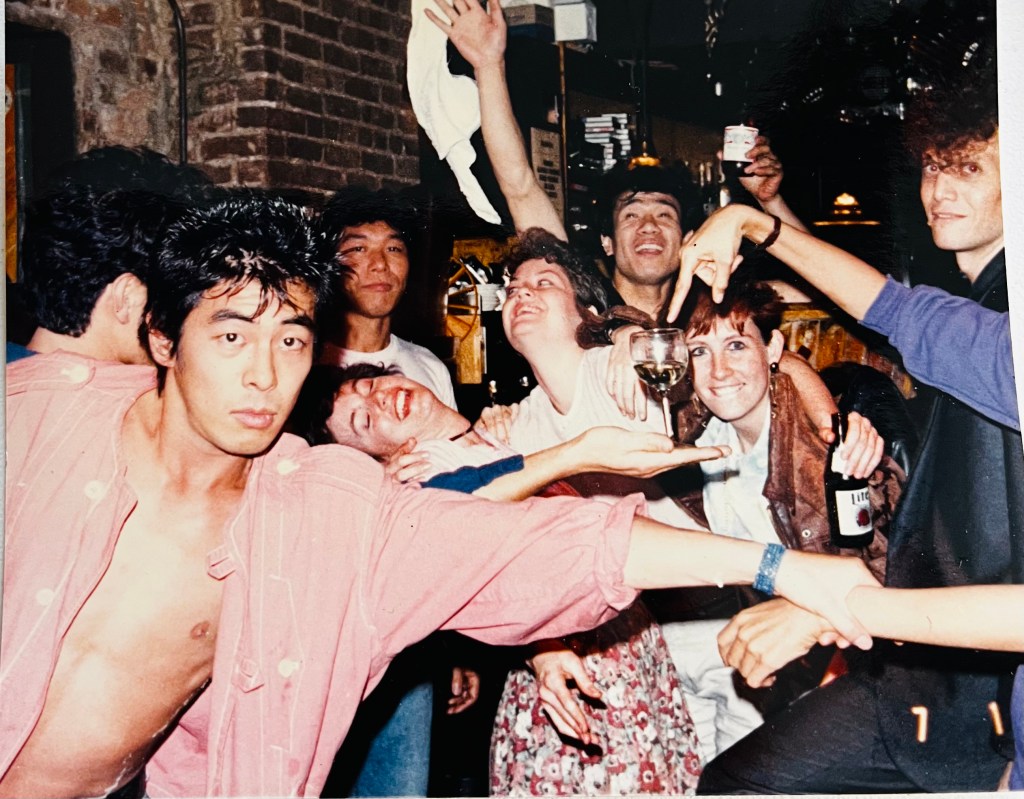
Classic summer roof party.