Cent-what? Tennial-who?

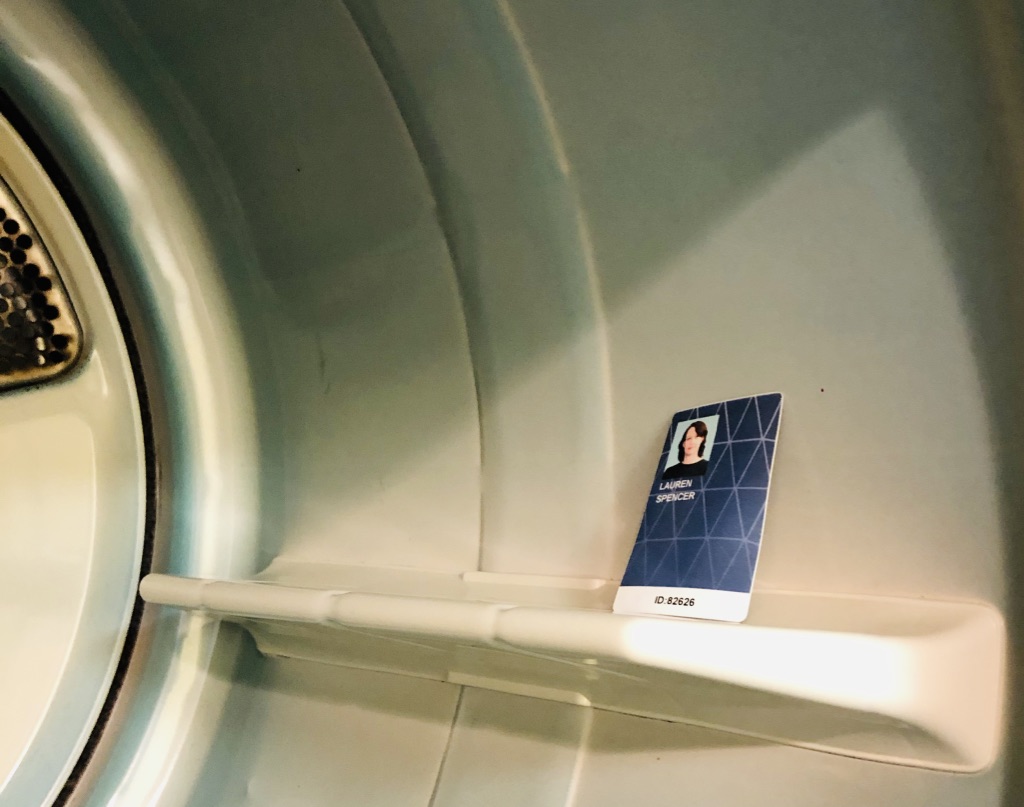
My last wash of 2019. NYC. Laundry room, Haven Ave. Hearst ID card caught in the dry cycle.

In December 2019, I began to write this blog on the regular starting with the series Jumpsuits Across America, which chronicled Dennis and my drive across the United of States from NYC to the Inland Empire so we could hang out with my dad proper-like. After arriving, the regularity of Does This Make Me went weekly. Funnily enough, as with so many ideas, the impetus came from a friend I’d lost touch with except on that trusty platform FB. She wrote something along the lines of “keep up the stories please” and I decided, well yes, fine, I’ll write a post every week and see how long that lasts.

I’ve hit one-hundred. A centennial’s worth of weekly ramblings and, again you’ve no doubt heard this before, it seems like both yesterday and forever this past year-and-a-half-plus. Supersized really. The fact all of us went inside and stayed there shortly after we arrived made time snap into a new form. Gave me plenty to ruminate on: coining the word “tweebles” (roughly, a clueless one who does not/will not wear a mask), Dennis’s weird toilet paper score in Target, racial justice moments that required soul-searching and scorching honesty, fires, guest posts by lovely intelligent women named Charlotte and Anya, an election that damn-near killed us (upcomings may still), Amanda Gorman, vaccines (!!!) and my dad (an essay about which was published in the LA Times after my friend and writing partner Judy said, “You know, you really should write up this post and get it published.” Thank you, Judy!), and a hella-lot of topics and shout-outs and love letters and angry missives. Made people annoyed, smile, all kinds of things I’ve been told.
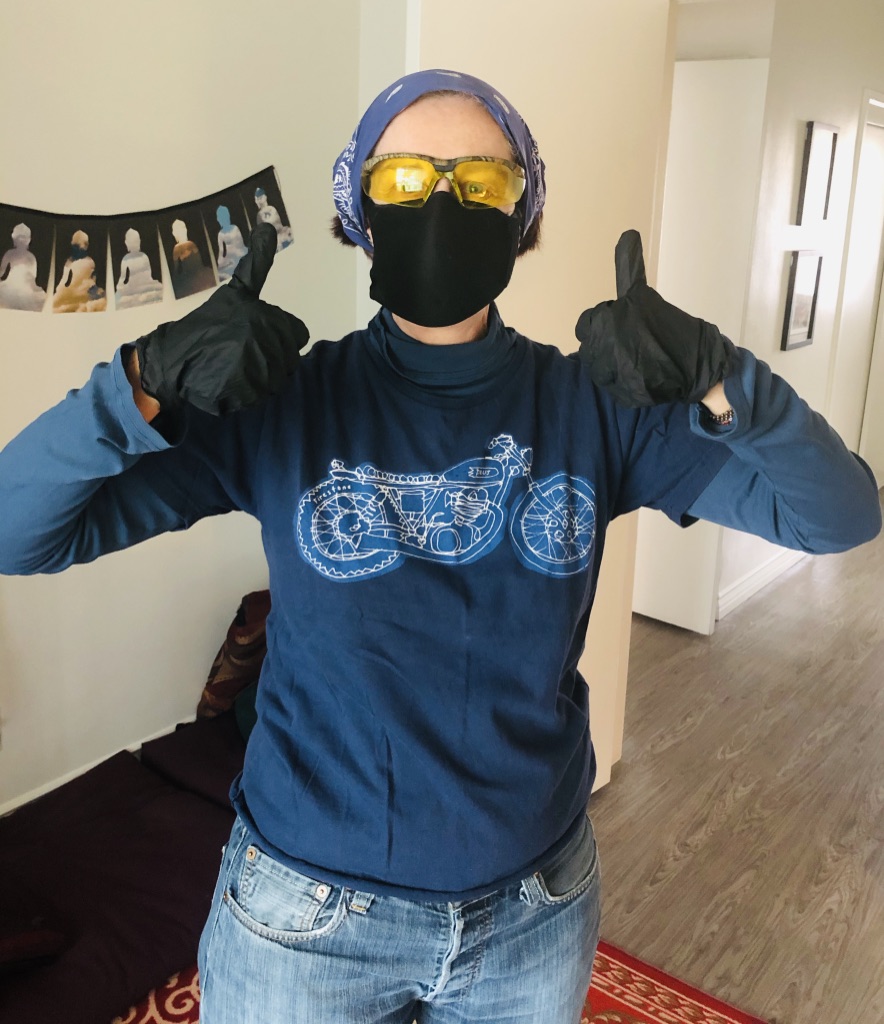
April 4, 2020, fashion statement: I made a mask out of a bra because of course I did. No choice really. Tim Gunn would be proud.

So how’s it going for me here and now. Looking back and looking forward. This exercise has without a doubt strengthened me as a writer. What I’ve learned is that the writing muscle responds pretty much like the deltoid(?maybe bicep?). Gets stronger when you use it regularly. Flexes looser but more precisely in the doing and doing and doing. All through my writing career I’ve heard tell of the benefits of journaling, morning paging, carrying a notebook and jotting things down. I never did any of that, except for as a journalist with a reporter’s notebook, but those were assignments. Now I see the usefulness of those recommendations. I’m not here to proselytize, more to say I understand now how the regularity of writing, which is in essence what I think those suggestions convey, really creates a fearlessness. I’m faster in the doing these days, not so much time-wise as letting ideas flow more smoothly. That’s not to say I don’t still comb over every week’s blog and revise, rewrite, and often scrap and start again. I do that. But it’s not the tension it was at the beginning. I don’t clench or pace as I did. I do still think, gaaah, crap, enough times to make me do it until it’s better. I mean, of course who wouldn’t love to just write it out and hit Publish. But no one does that. Seriously, no one. If a writer says they only do one draft, I’m pretty sure their fingers and toes are a mess of crossed behind their back, in their shoes.
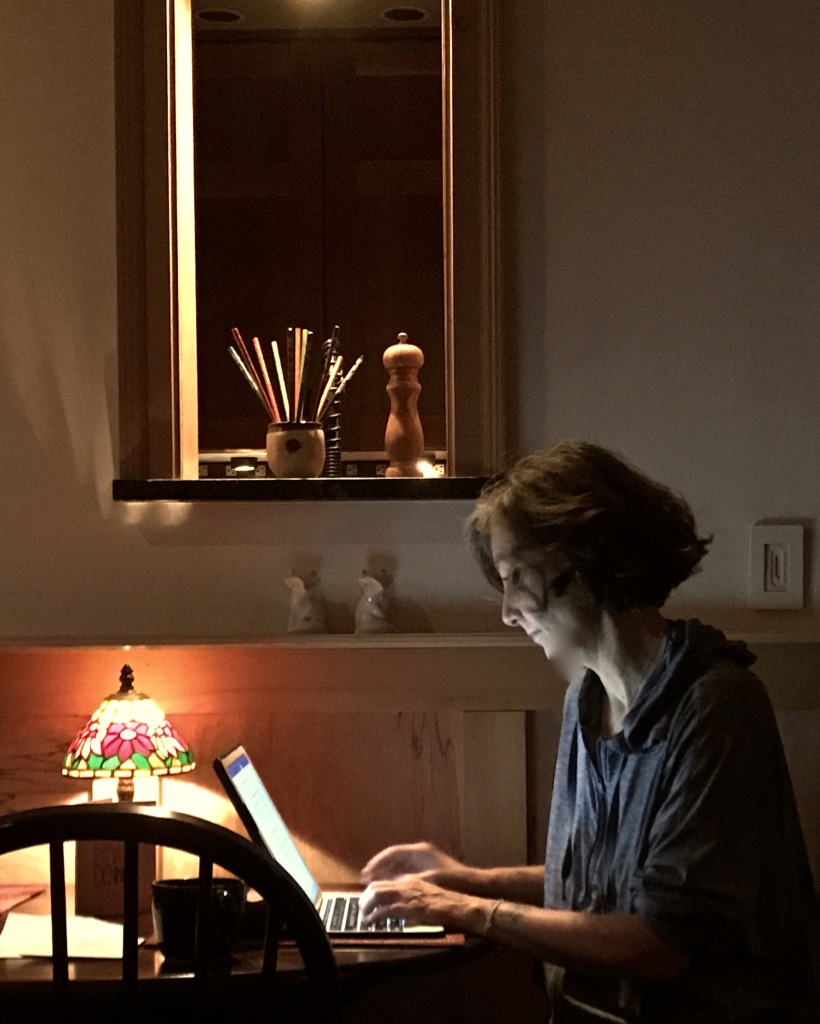
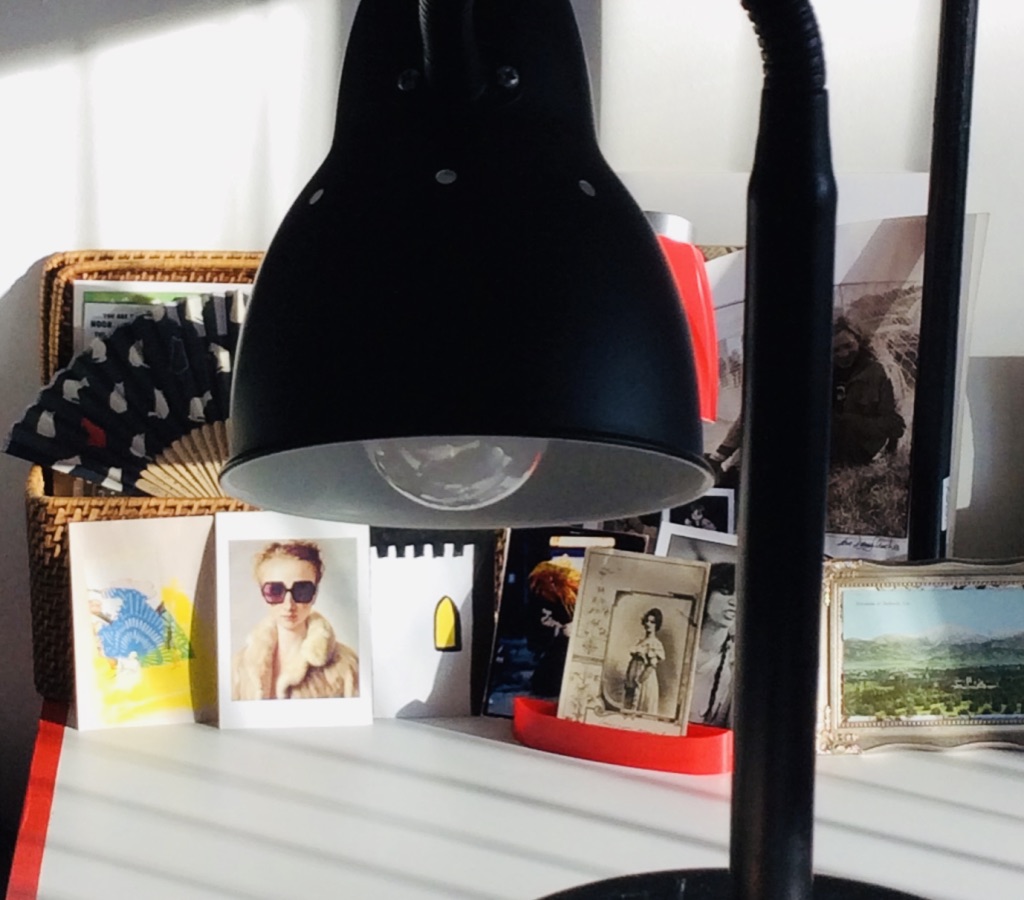
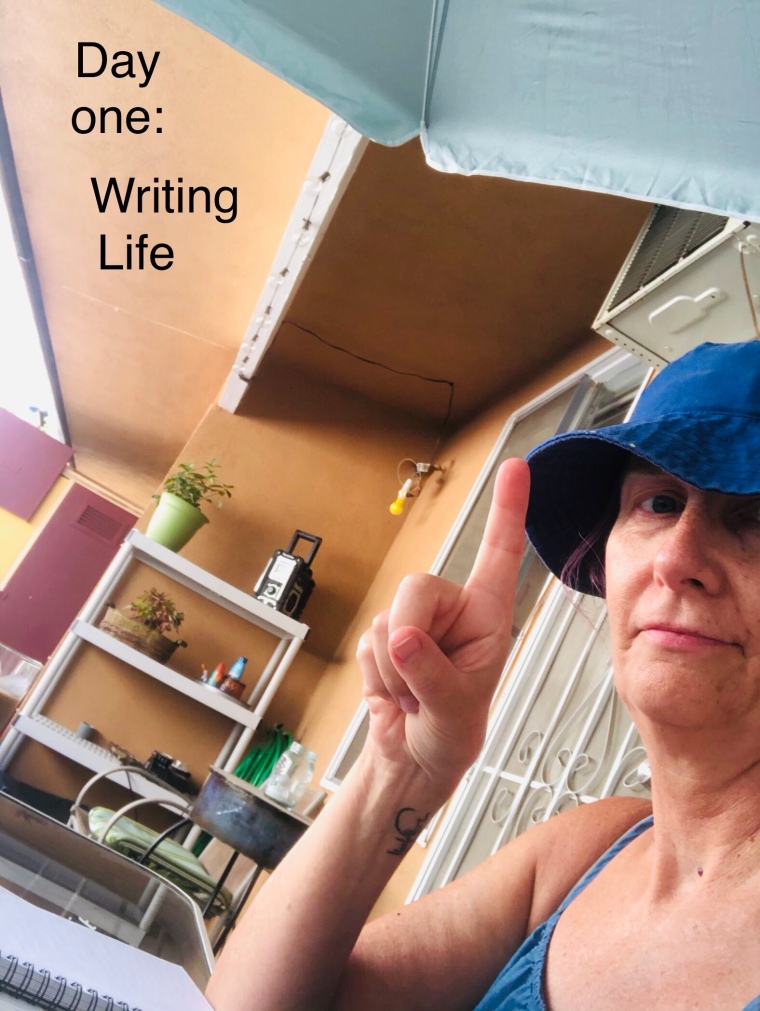
So naturally I find I don’t have many photos of me actually writing, and in fact the act of it is really pretty boring to watch from an outsider’s perspective. Nothing very riveting about someone disappearing into the interior of their own mind. Maybe like watching paint dry (BTW, for a really pretty cool clip about that, please watch this). Yet on the inside it can be like a whole population of people chattering away and attempting to empty themselves into alternate forms. That’s either the description of schizophrenia or a writer (maybe an actor pondering a scene or a painter a canvas? Maybe also a scientist or mathematician. Fine. Lots of people don’t look all that groovy or active when they’re creating.) Ultimately, this blog has given me confidence around that very act and I’m so glad you all are there with me. So. Glad. Thank you for coming along when you have and we’ll see where the experiment, the flexing, and limbering takes me and us next!
Unconscious

“They can’t say no if they’re unconscious.” Overheard. Neighbor next door. zzzzzt. sound of my adrenaline amping up. heart in ears, head exploding. While I fully understand that he is in fact the one unconscious, and that ultimately he’s not worth even one more mention on this page (or in life), what washed me with acid was how the words, stacked one on top of the other, remind me that misogyny is an active construction site with workers scrambling away turning comments into walls, floors, and add-ons of hatred. And no, don’t tell me this is just someone making a joke and to lighten up. It’s most definitely not and I most certainly won’t.

I have so many thoughts here, I hardly know where to begin. “Start again.” I first heard those words during a meditation retreat years ago as a reminder that we’re constantly starting, constantly failing, constantly achieving, then falling away again. And, ultimately, starting. Again. And it’s all absolutely part of what we do to be human. So in the spirit of that, here’s where I’ll start. I’ve heard tell that getting to know a person one-on-one is a way to understand and/or cross great divides. I understand that. I think I’ve even done it once or twice. Yet, for me, when I hear words that tell me a person is violent toward an entire swathe of humanity, then how’m I gonna even find a common welcome mat to cross in order to have a conversation. That door’s shut. In fact, I can’t even find the damn door. Or window. So where to begin? Words are powerful. What lies beneath them even more so.

It’s not lost on me that as a white woman of privilege, I haven’t lived in the daily/hourly barrage of buckshot nouns, verbs, adjectives, and all other attendant word weapons hurled toward people of color, folx in the LGBTQ community, all those who are disabled or differently oriented in any way. To be constantly in that place is to understand why stress, anxiety, and also anger, rage bring on very real consequences in our health-care and penal systems. To suggest people just get over it is to literally miss the point. How do we work with that? More listening? This seems at least a beginning, even if the ones I wish would turn their ears to the conversation don’t seem interested.

Years ago, during a silent retreat, there was much talk about misery. Those who live in it. Nothing to do with money, housing, earth-based comforts of any kind, but rather the misery of living in a mind where your thoughts are made up of fear of other, vindictiveness, anger. The goal of understanding that person’s misery, not feeling sorry in a patronizing way, but more accepting that’s the space of hell they live in. Whether that will change for them is not up to me, although there is thought that change can happen. So I can hold that idea, yet most the time I feel frustrated and not that generous.

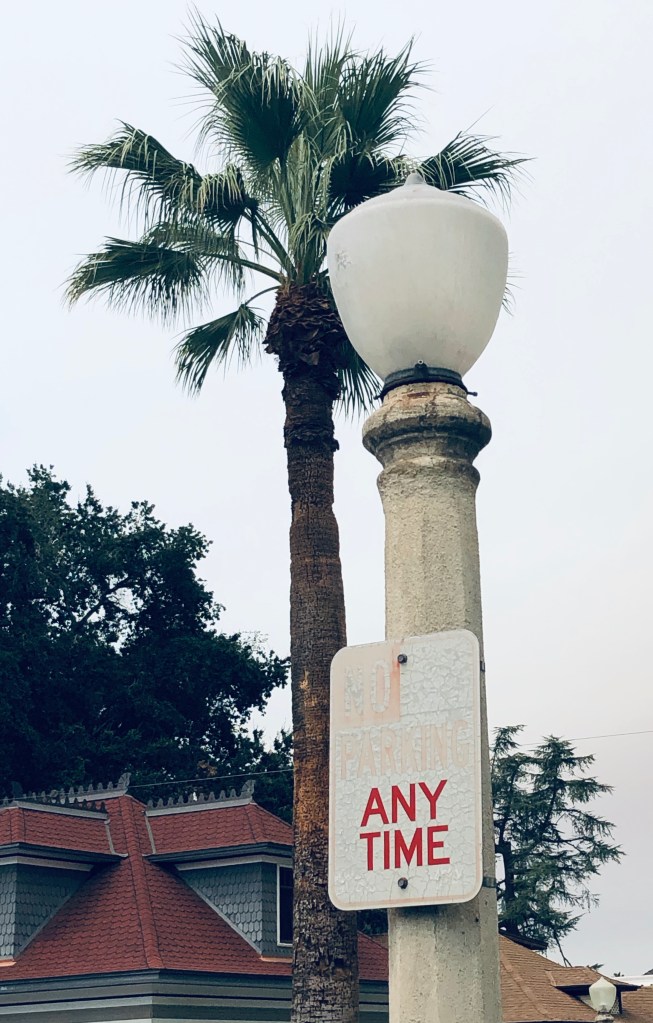
Today, after the overhearing, my thoughts were a raging whirlpool, so I reached out to two people who listened and made sure I was fine to go out and play in traffic, which basically meant riding my bike to the Y, getting in the pool and swimming a bunch of laps while working the emotional adrenaline into trails. The day was sharp and bright. One of those chamber of commerce affairs (my friend Elizabeth reminded me of this term) that are so iconic with palm trees and blue sky that you can imagine it being on the front of a SoCal brochure.There was a delightful woman at the Y who said jolly things that made me smile. I was happy to feel some lightness. Then I came home and wrote it out. Able to feel more conscious about what I wanted to say than I had earlier. I appreciate that.

There are many more things to say, of course. Maybe a part 2 to this regarding the root of my own history with being in a room while people are saying and doing inappropriate things. How I regret not being more conscious in those moments. About the delivery system of words and how they can shatter, bolster, make people question. (I include here two interesting takes on what word/actions/images can move people to do: Dave Chappelle. Bright Sheng. These are both also available outside the NYTimes system.)

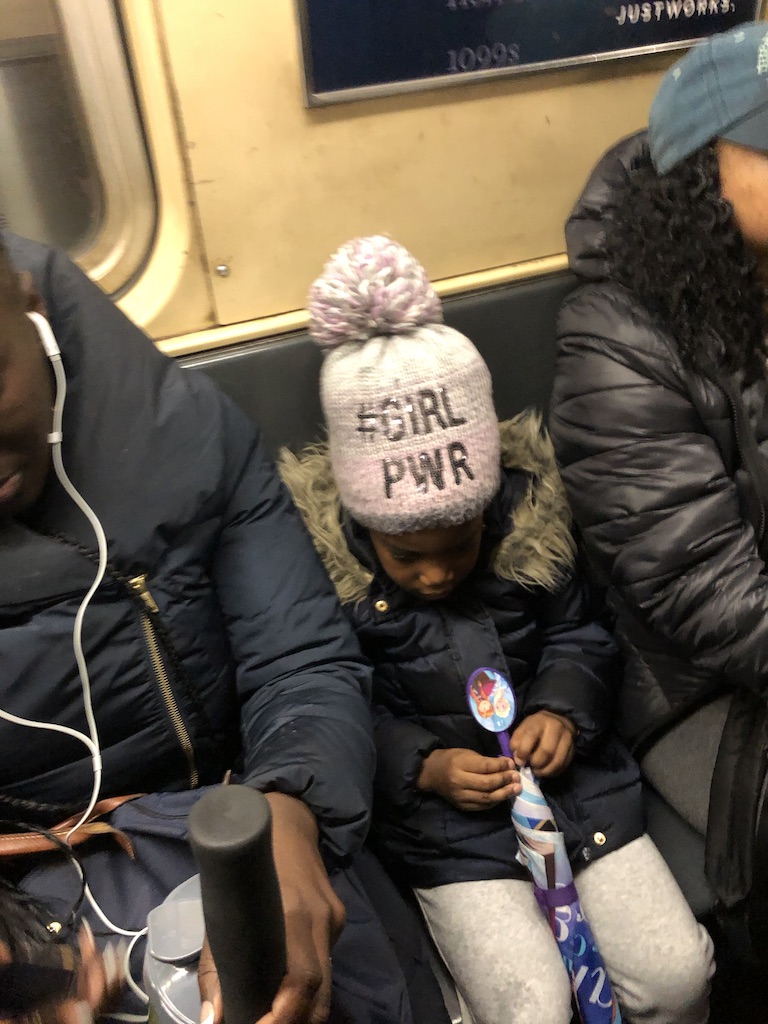
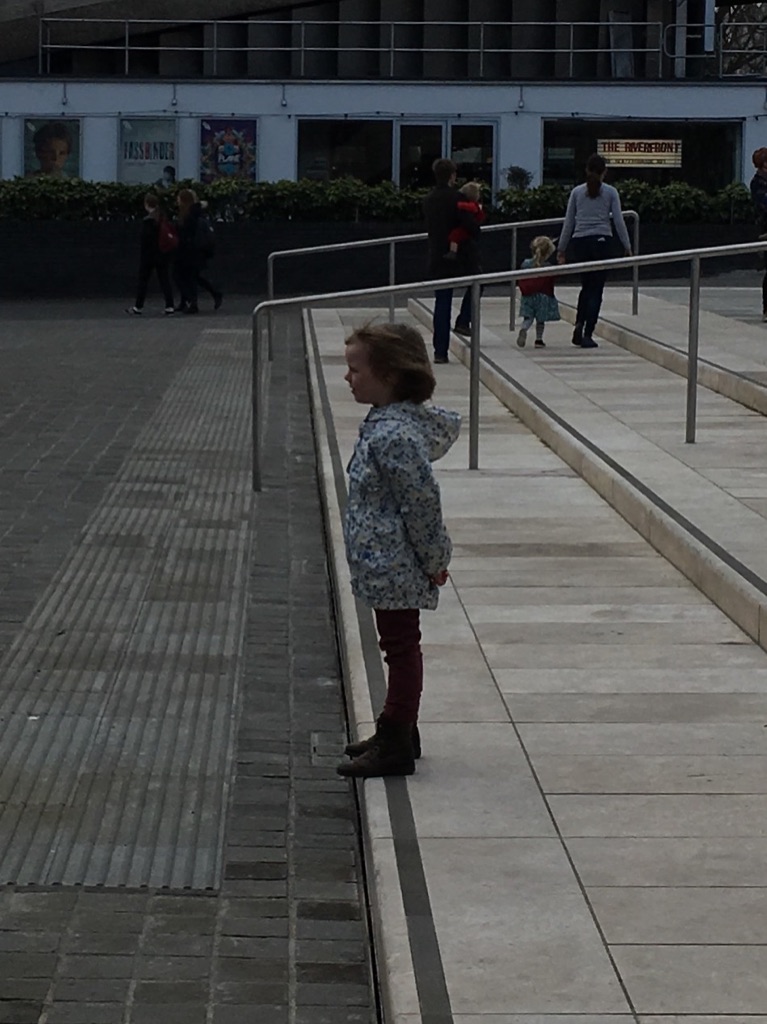
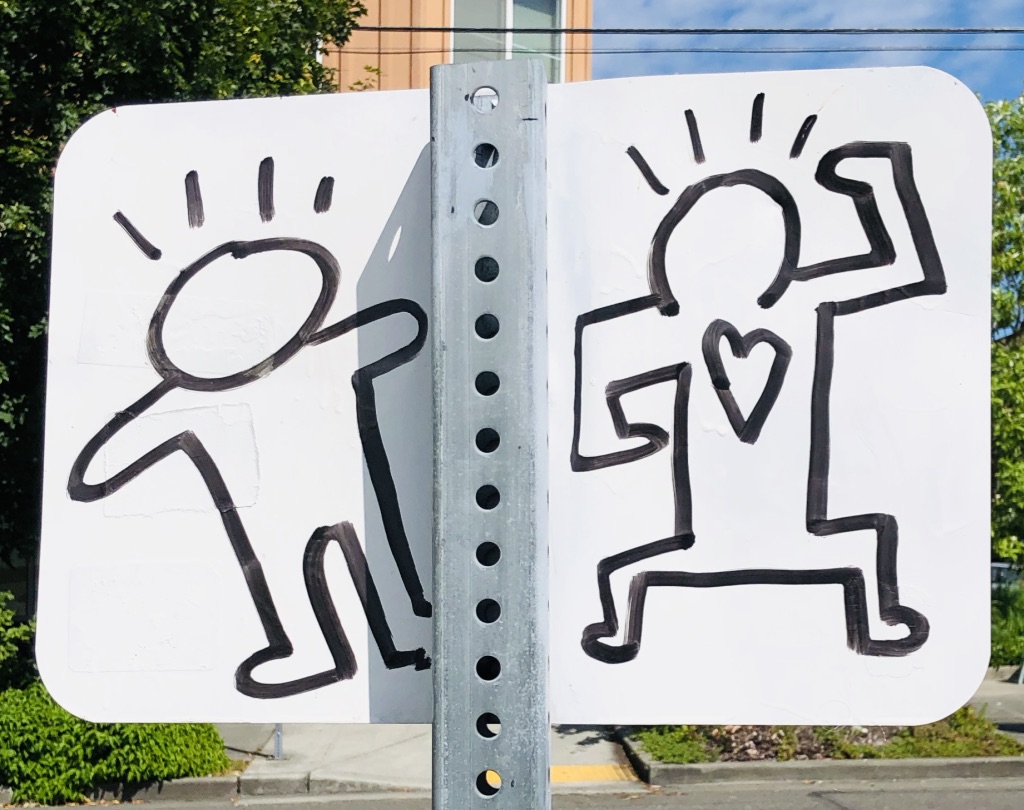
What I want for the women on this page, who I’ve snapped over the last many years, is that if they’re wee ones, they have powerful humans around them to remind that when they run into misogynists, which they no doubt will because I don’t think they’re going away anytime soon, that they have a strong scaffolding of enlightened people around them to explain about how misery in others works. For the olders/wisers among us, that we are both the scaffolding and the building blocks to pave the message that misery doesn’t have any place in our house.

Scary

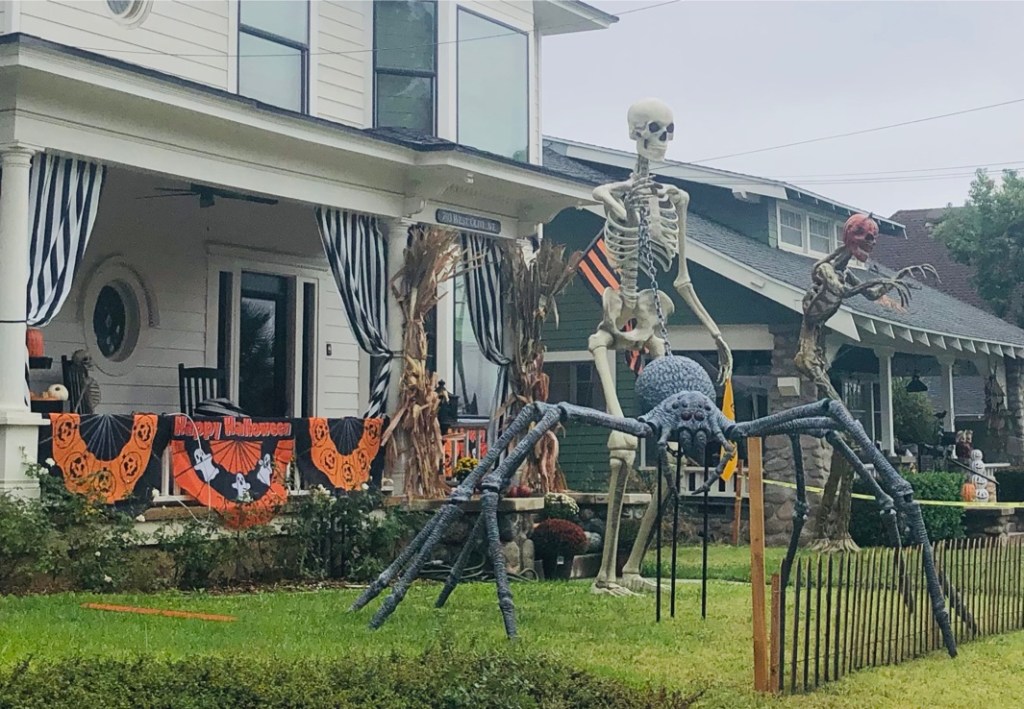
I live in a place that takes Halloween very seriously. Not just excessive spider-web-like drapings and a jack-o-lantern with a knife in it, but lawn displays with two-story tall skeletons and giant (like seriously huge) spiders (see above). (I’m thinking Christmas might feature a robotic Santa, Mrs. Santa, Jesus, elves, wise men, not-wise men, livestock, and maybe a huuuuggggeee candy cane. Stay tuned.)

Having lived in NYC for thirty-five years, Halloween for me meant taking a taxi home if I’d gone out since the throwing of rotten eggs was pretty much a citywide sport for a certain age, or rather, personality. It was my least fave holiday next to the fourth of July (M80s thrown down airshafts anyone?). I’m not one for horror movies either given I can scare the crap out of myself by simply taking a look/listen to the news or, at certain times, lingering on my bank account. I know there are theories around why some folx are drawn to horror movies. Something to do with recognizing what you’re seeing as fake while feeling endorphins pump through your body, kind of like riding a rollercoaster. While I went through a period of riding the Cyclone (in the front car) at Coney Island and can relate to the sensation of having the bejeezuz scared out of me and then it ending, that rush never transferred to watching Jason or Freddy. The psychological twist-case films are hands down the worst for me. Back in the day, my friend Mary and I went to see a Silence of the Lambs matinee and were so freaked walking out onto the streets of Manhattan afterward that we either A) went for creature-comfort hot chocolate or B) went to a bar and did shots. I can’t quite remember which, but it was something not normal for a summer afternoon. But it felt absolutely necessary. Watching Seven actually pissed me off. The horrors that weren’t shown stressed me out so much I got angry because my mind tried to fill in the unseen and I couldn’t let it go.

Neighborly chatting.

Of course, investigating the inner scary is an almost daily activity. I mean that more in a full-spectrum of feels way. Personal look-sees. Throughout a day, there’s the joy, the fear, the sad, the thrill, and all kinds of other things, even if in little seismic movements that I have no idea are happening. I step into and through them like puddles, sometimes feeling a slosh, other times stomping around a bit longer. And no surprise, I’m often more aware of other people’s splashing around than I am of my own. Nature of the beast.

The other day I read an article a good friend brought to my attention that hit like a tsunami. I gasped, cringed, no-she-didn’t-ed. “Who Is the Bad Art Friend” in the New York Times. (If you don’t want to scale the paywall, click here.) It’s truly worth a read for a whole lot of reasons, navigating levels of humanness like some Super Mario Brothers game gone berserk. A kind of choose your outrage tale that covers, in no particular order…it’s one big quilt…the question of authors and ownership of ideas, of extreme virtue signaling (or what we used to simply call “showing off” although this particular type is nuanced), of tone-deaf and blind-spot moments in service of privilege, of some exposure to mean grl/gy activity, and also a gaping chasm where self-awareness would normally live. It’s got it all.

As I read it, there was one particular section that really poked at me sharper than the rest, and I’m not gonna lie, the ENTIRE piece was like emotional acupuncture top to bottom. Although I hate exposing myself to things I know will scare me like, say, horror movies, I have come to understand through oodles of therapy and such that being curious about the thing that makes me squirm is really useful. And insanely hard. Of course, my entire self attempts a getaway. A look-shiny-object-moment just so I don’t have to pay any mind to why that emotion is gripping me. In the case of this article, it was the sense of a woman seeming so desperate to be the person she’s presenting to the world, or in fact thinks she actually is, that her unawareness of how people are receiving her is null&void. Her proverbial blindfold tied as tight as the choker in that horror story “The Velvet Ribbon.” If it comes off, she’ll fall apart. The world will see/she will discover her whole self. Scary prospect. Necessary perspective. A great quote heard on the TJL podcast this week (didn’t think I could go a month without mentioning them, did’ya?): “It’s incredibly seductive for us to want to see ourselves as virtuous…. We can fool ourselves into thinking we’re paragons of virtue but something inside of us always knows when we’re full of shit.”

more subtle

This fertile subject struck a chord for me. Last year when George Floyd was murdered, the question came up, “why now, white people?” and of course there were myriad answers. For me, the toggle between paying attention quietly and being active loudly was a learning curve I’m still riding like the Cyclone. Another TJL podcast quote: “Moral outrage [often] assuages feelings of personal responsibility for bad things going on in the culture and reinforces our own status for ourselves and for others as a ‘good’ person.” Yes, I get that absolutely. It’s the thing that pricked me particularly in the “Bad Art Friend” piece. If having the confidence to stay where I am and listen to the small voice inside means I’ll act based on a purer instinct than reacting, that’s a direction I’d like to move in. But if given the keys, my ego will get behind the wheel and just flatten, drive over, leave in the dust whatever self-reflection I may have around the work and the quiet it takes for the small voice inside to be heard.

Understanding I present as much of a cliché to the world as anyone else is a useful start to bodychecking that ego into the back seat. Meet me: white, woman of a certain age, feminist, liberal, college-graduated, meditator, vegetarian. Them’s a lot of boxes checked. And although even if I had a lawn, putting a “Love Lives Here” sign on it isn’t my thing—nor would I put a giant skeleton or spider—anyone just meeting me might imagine would. And for sure there was the Biden/Harris banner that stretched across our window for many months last year. This is who I am. But I also have a trunk full of stuff that stays hidden. That I look away from. Like being at the gym and pretending the woman who I assumed was homeless was invisible. That stung me on a few counts: my assumption, my ignorance, my unkindness. There are the racial and social judging thoughts that flash into my brainpan. I more often than not assign a mental post-it to them that reads “investigate later.” Sometimes I get annoyed hearing people laugh. My trunk jangles with unexplored moments like that. Do I think they’ll just disappear? I know they won’t. Do they scare me like a horror story? Sometimes. Because I think to expose them, invite them into the passenger seat, will let people see a side of me that’s ugly. Human. I am the cliché for sure, but I’m also a good bit unexpected monster. And perhaps in understanding that creature, a little twist on Frankenstein, I can continue to understand how to do better by it, warts, bolts, and all.

The Many Lives

Back. in. a. day.

At the end of September, a few stories popped up around the 30th anniversary of Nirvana’s Nevermind. I was surprised, not because it had been 30 years—that bit made sense—but more because I just hadn’t clocked it as an event upcoming. Had completely put out of my mind that markers and anniversaries mean stuff, especially in things like music and art. I’m not mad at that reality. Time spans are as good a thing as any to review what’s happened in history and how the intervening years have unfolded for both those involved and those who held the event as important.

On the 20th anniversary of said release, I wrote a piece in the Guardian about the album, band, and its subsequent impact and while at first I was nervous to revisit that period in my life, the experience ended up being cathartic. But even then I felt I’d lived a few lives since hearing, loving, and standing in the full-force wind of Nirvana’s music and the movement it hurricaned inside of. The adage forest-from-trees comes to mind. I’d be lying if I didn’t say I knew that span of time and scene was electric, fractured, complicated, effin’ amazing. All those feels also had to do with my understanding that I was actually doing what I loved: writing about and documenting rock’n’roll music. Ever since teenagehood, consuming Creem and HIt Parader magazines, listening to shaggy British bands who wore their jeans really tight, I’d wanted that job. And, once getting it, I buckled in and went for the ride, eyes open, trying to hold onto my pen. Losing its grip on the regular while watching my reporter’s notebook fly off the ride and I’d think, Damn, hope I can remember all this. There was an adjacency to the magic that was potent and much looser than it seems to be today. Publicists were different back then. Not as much security and vetting of stories. You actually really could set up an interview and step into the room without reams of resistance and the stern parameters around stories that exist in this century. But because there were no guardrails inside the industry some very crappy things were happening (I’m looking at you sexism, bullying, racism, general shittiness).

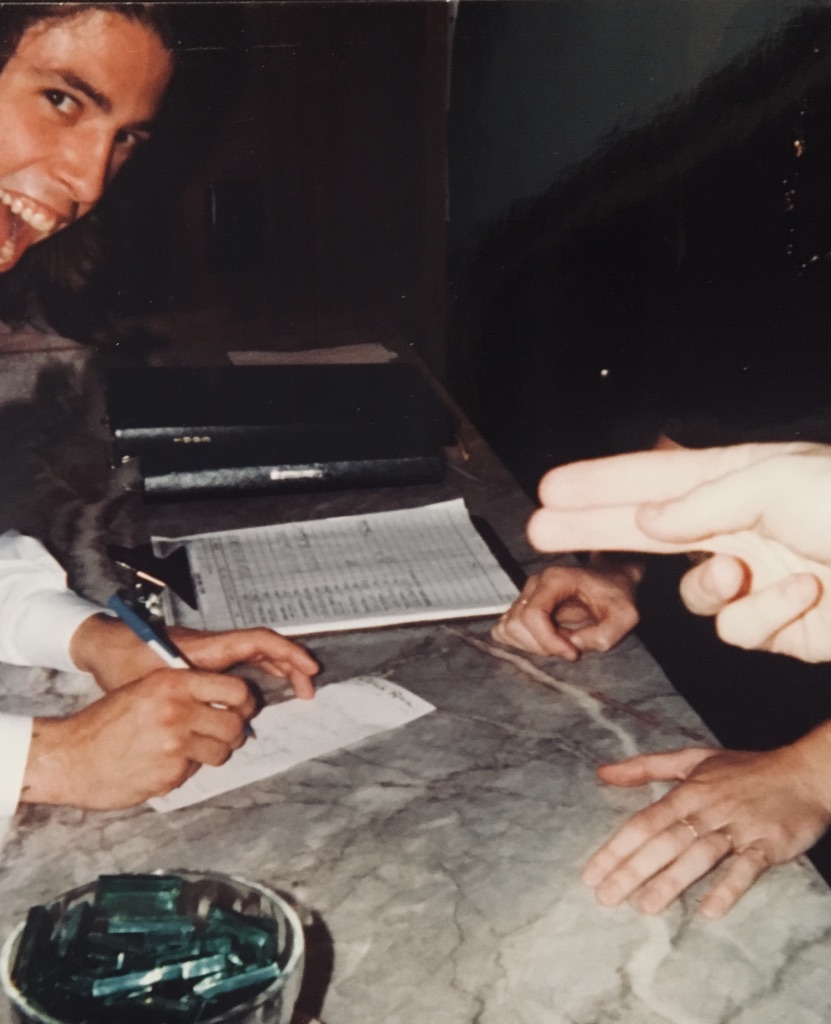
Maybe he’s paying the whole bill, but I doubt it. No one really had a lot of $$ back then. Signing bonuses were inflated. (for a good view in on this topic, this episode of You’re Wrong About). There were still free mints tho. Also RIP Seattle’s Cloud Room where this pic happened.

And also because it was such a wild ride, when I did get off, knees all shaky, equilibrium upside down and sideways, my instinct was to step away. Very far away. I ended up going into NYC public school classrooms and teaching writing workshops because I actually wanted to be with nine-year-olds who acted mostly age-appropriate. One thing I forgot to do was pay attention to why I felt so keenly that I had to step away from music altogether. Or at least investigate what lay beneath. Look at. Wonder why I ran screaming from the building. Obviously, that’s a big heaping bit of hyperbole, but in my mind, I see myself actually running toward the revolving door out of the Elektra Records offices at full speed with my hair on fire. In reality, I simply didn’t renew my contract as head of video promotion, then packed up a cardboard box and took a car service home once my last day was over. It was September 1994. The April before Kurt Cobain had died from suicide. I found out Kurt was gone as I sat in my office with Huey Lewis (remember him and the News?) and his manager as they grilled me on why VH1 was not rotating the video from their newest album. I remember thinking Wait. What? How? Why am I sitting here talking to these guys? Oh, shit, I have to keep it together. I watched their mouths move and that’s about all I remember. I didn’t run screaming anywhere at that point. I didn’t even reach for a bottle of anything, even though I knew where one was.

In Rage Becomes Her, author Soraya Chemaly talks about how often women are expected to show the world a calm outward face while guys gnash teeth and rage around without anyone shushing them. I kid you not, there were wails, gnashing, and high-emotion from adjoining offices, yet I finished the meeting. Reality check: I’d been shoving store-for-later emotions down deep for decades. (Side note: Chemaly also brings up some very stark stats around women leaving the industry where they’ve been unheard, unseen, and harrassed within five years of incidents happening or situations building. They usually end up in jobs far far away from the industry they’ve left.) When I did leave that job for good and the business for real, it felt like an amazing weight off. But one I never talked about. Just, you know, moved on. Actually left a lot of the friends I’d had at the time behind. Got married, which was really the ultimate hide for real. Since then I’ve reacquainted with most of those friends and unacquainted with the marriage. But only fairly recently have I looked into the closet with the various (metaphorical) rubber maid bins holding eras of my life and thought to fully unpack them.

I know there are a bunch of false bottoms in those bins. I open one, a hole at the bottom gives view into the next. I understand on a very basic level that I’ve lived all these moments. I recognize how my fiction is play-doh-ing them into stories (or maybe Mr. Potatohead-ing), and how this really is my life. And I do love it. I actually love it more now for the distance. The other night I was talking to friends who I’ve known for well over a decade and they wondered how it was some of these stories around brushes with music&people were just coming up now in conversation. How had we never talked about it before? Such a good question. This grab-bag of things from what I sometimes think of as my former life are actually moments from this actual, real, yes-I-remember-well time. And you know, I’m not in any way sad about that. It may just be when I’m told to remember because it’s been X-amount of years and that time was really important and let’s remember why that I balk, but that may be because sometimes I respond like a nine-year-old.

Making Time

As if I could…do that thing listed in the title: Make time. Actually manufacture it. Have some sort of spinning wheel where minutes could unfurl like a long piece of fabric. Or maybe a 3D printer would work better. Or perhaps this would all become a dystopian nightmare like in the book The Age of Miracles (which is a goodie, BTW). Maybe this is pandemic layover stuff: that for a year+ while busy with some stuff, I was also exempt in a large way. (I suspect maaany of us feel that way). It’s not as if I’m being excessively social (not even being mildly social, actually), it’s more a time management issue around how time and my creative stuff go together. The idea that even though I don’t get paid for it so therefore I feel I should be spending my time with the paying activities, it’s naturally the thing I want to spend all my time doing.

The phrase “time management” is an oxymoron, don’t you think? Like really. Manage a slippery monster called time? Good luck with that. I can see there are limits to put around the thing. Unions have managed to set terms around worker’s rights and time. The entertainment industry has sort of worked out a system for how time is used for visual and sound mediums (although there are clearly outliers: the movie Cleopatra clocks in at over 4 hours and the song “The Whirlwind” by Transatlantic at 77 minutes. The first starred Liz Taylor and included a pretty hefty bit of history…so… fine. The second is by a prog-rock band and to hear it end-to-end would quite literally be my definition of torture. Given the choice: Hot pokers in eyes or headphones over ears. No contest.). A book I just bought, Four Thousand Weeks: Time Management for Mortals by Oliver Burkeman is fantastic on this topic. I heard him interviewed here and he made me both laugh and loudly exclamicate in recognition (mask covering mouth during weekly epic walk, so less staring by other humans when I made those noises). He talked about the mentalness of thinking that by finishing a (lengthy) to-do list, a person will then think, Great, the deck is clear and NOW I can focus on what I want to do. But, big BUT, there is never a real tangible end to the list of to-do’s. So how to navigate into your want-to-dos without feeling like A) you’re ignoring the need-to-do stuff and B) how not to feel grumpy, angry, cheated, sad because you think there’s never time to get to the want-to-dos. (He has a great column in The Guardian cheekily called This Column Will Change Your Life. The column will also make you chuckle, maybe actually laugh in that big way that makes people stare but feels so good.)

Prague, 2017

So, you know, time. It’s apparently here to stay. As reliably frustrating as death and taxes. Solid and dependable as … I actually can’t think of anything solid and dependable. You can take it, spend it, lose it, squander it. Manage it, not so much. And that’s all I have to say about it, except I’m excavating, then building a fence around a plot of my own where I’ll spend some time on my own creative playground. At least that’s my goal. To all of you, please have a good week ahead with some moments taken, spent, lost, and squandered on things you want to do.

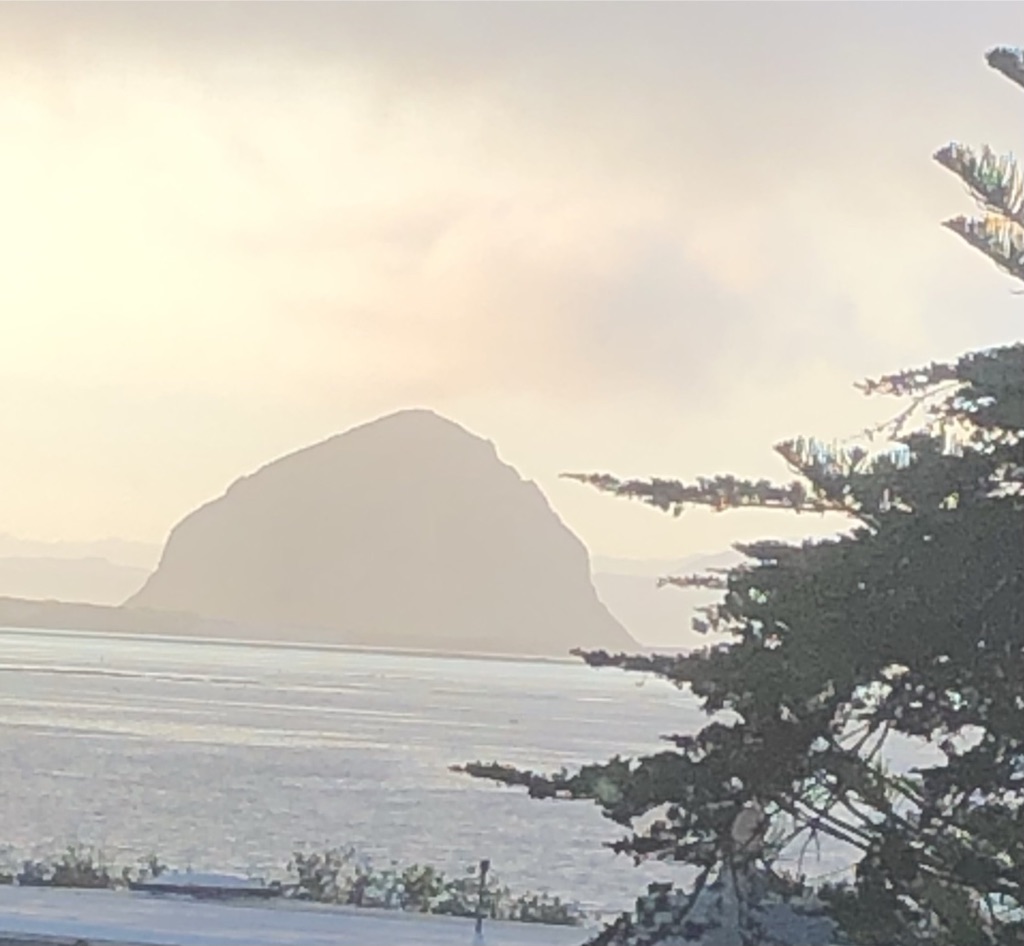
Morro Bay boulder, Northern California. Solid and dependable? Standing the test of time?

Time in a Bottle

This is about right (courtesy Beth & Julian)

Hello fabulous folks. Just back from the opposite coast. Being toe to toe with people I haven’t seen since 2019 was wonderful/fantastic/beyond great. My heart was saying Wait, didn’t I just see you? AND It’s been too long (both of those things able to survive side by side given FaceTime and Zoom capabilities), while the orientation part of my brain was shouting what-train-do-I-take-to-get-to…? (Mind you, we were staying out in Brooklyn on the G line, so whaaaa? Had a whole new transit experience.) The post-pandemic city was more evident in certain neighborhoods. We didn’t go to the theater district, but a couple of shows opened the night before we left (I’m looking at you Hadestown, Hamilton, Wicked). The upper east side (visiting a friend’s art studio) had a lot of shuttered stores, while Chelsea and the West Village had a lot of life among the new dining sheds lining the streets. I’ll chalk a lot of that up to tourism eeking back in and the creativity of figuring out how to keep going by building out where the wild things are. Time and its elasticity had me feeling at home while also not sad about being in California.

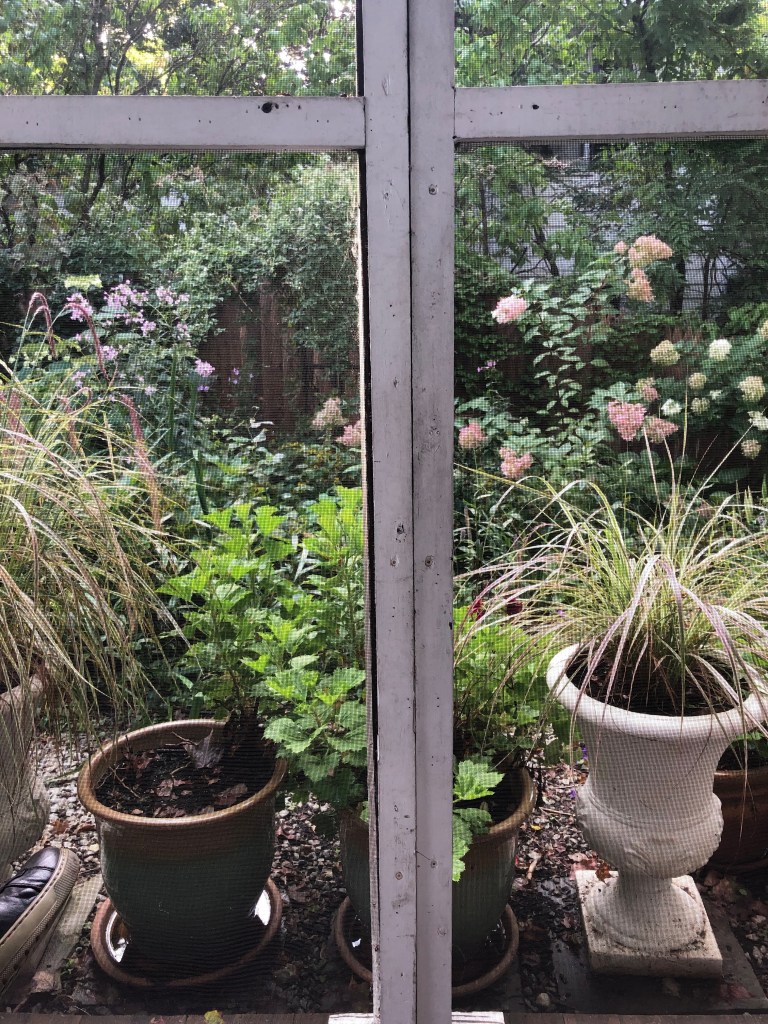
Upstate side porch view (also courtesy of Beth and Julian)

For the last two days of the trip, we stayed upstate with dear friends whose house has a side porch that I became fixated on as what I want my writer’s studio/space to look like. Open on three sides with lush greenery right outside the window/screens, the sense of both being in the world and removed from it was inspiring in an “I could write here for hours” kind of way. Which of course brings me to the romanticizing of that kind of work.

In the last year I’ve begun to understand more fully what it is to be a writer of fiction. The mix of commitment and realism. While I used to fantasize about having whole days to just write, the reality of doing that is obviously more complex. The frustration of staring out the window/at a wall, working on one paragraph, one page, one sentence for HOURS, then being sure I’ve made it worse. But also the tingle of moving forward and thinking Yes, that works. Time does evaporate when I’m doing what I love.

During one of my amazing catch-up-with-close-friends meals, I got to talk about the difference between journalism and fiction. With the former, when I was on assignment, it was a story either pitched by me or by an editor for me to take on. There was a deadline, research, interviews. The piece becomes immersive and has a structure (word count and flow, tone and voice). With fiction the parameters wiggle and widen. There is a story in my head, no one has asked for that story, I’m just hoping by the final draft (however many iterations that takes) someone whose job title is “agent” will be interested and like it enough to take me and my creation on. Yes, there are general word length rules. Yes, there are actual necessary editorial choices to keep the thing moving, although you can read about a zillion do’s and dont’s and the more I do the writing, the more I can see which ones really are true for me. Listening to podcasts with writers (love How to Fail, because it’s so great to hear about things not working and how authors face that, Write Off—and this one with Shuggie Bain author Douglas Stuart—is amazing, and In Writing too), reading books from writers about writing (oh my gawd George Saunders A Swim in a Pond in a Rain, the BEST!), checking in with my CBC writer’s group, who are to a one so smart, talented, inspirational, and, finally, having Dennis here to bounce things off of is all amazing. But in the end, it’s solo sailing. Not that thrilling to watch or describe. (How many movies about writers are exciting? Maybe As Good As It Gets nails the misanthropic writer type? There’s a cool typewriter in Barton Fink…)

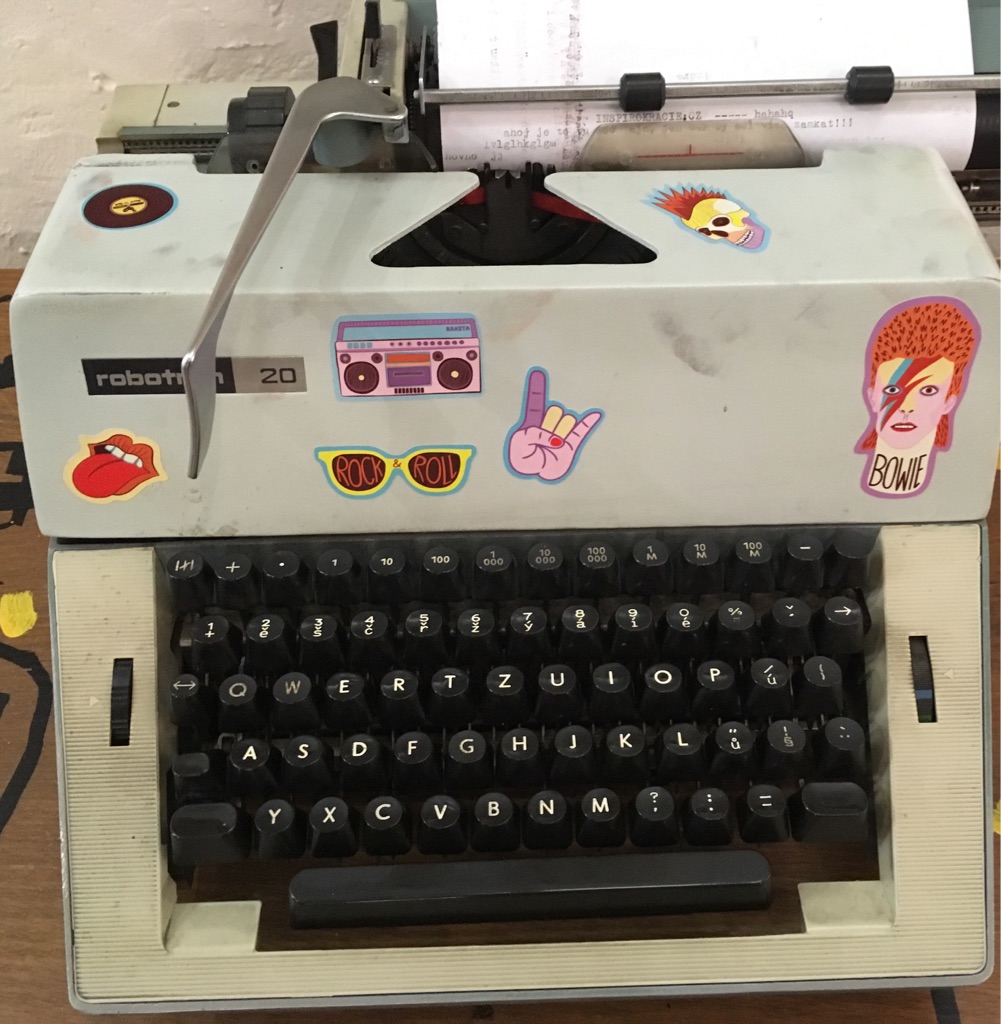
Cool typewriter in Prague. Notice how the Z and Y placements are swapped?

I hadn’t sat down to work on my novel for the week we were away, although I was thinking about it constantly. What occasionally would clench my heart, make me anxious, was thinking What if I never get back to the rhythm of the writing? Where am I in my revision anyway? What if the muse is gone? Because, you know, no one is waiting on this. And my teaching schedule is ramping up … and … and…. I mostly recognize this as fear. I can feel the itch of wanting to get back and being afraid to fail, even if I do learn how to fail better.

Though I did sit on the plane home and work over my first page for five effin hours, so I obviously jumped back in the water when I had the chance. Another something I read a few days ago by author Jami Attenberg who has a great newsletter called Craft Talk (when you subscribe, the money is donated to a chosen nonprofit/cause. This week: Funds for the People of the Bayou.) was her take on how we mark time and accomplishments. “It’s possible that there isn’t much difference between the end of the beginning and the start of the middle.” I love that because it’s both comforting to see the non-linear bits around a story and how life in general doesn’t track the beginning, middle, ends as clearly as I might have once thought.

I don’t even know how to end this blog except that I have to go get the laundry, because the buzzer went off so I know that’s truly finished.

Unprecedented

Can we talk about that word? Unprecedented. MiLord, if I had to take a drink every time I heard during our nightly viewing of PBS Newshour or read in my perusal of daily news the word unprecedented, I’d be lit nonstop. This would not be good for anyone. Like anything overused, I think the power is lost when the thing in question—in this case a word: unprecedented—becomes run through the mental, social, media washing machine so many times that the original shape and color loosens and fades. It’s like my favorite Nirvana t-shirt that is nearly unrecognizable because the logo has sloughed off and the arm holes are sagged (and BTW, I must point out that the cotton t-shirt of the nineties is a different animal than the cotton of today. i.e., less bounce-back-able. But people, on the topic of cotton, we all must check our clothing sources to try and not be complicit in the Uigher human rights issues around clothing manufacturing. Jeezuz, there’s so much going on, I might just have to go naked. Drunk and naked. This year may take me there.). Enough digression:

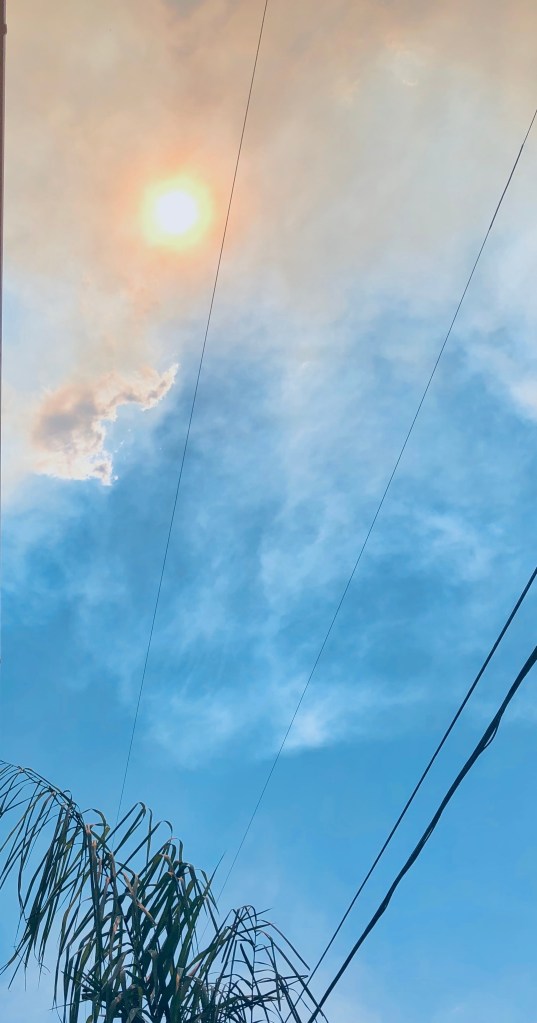
Last weekend’s view of the sun from the backyard (note still peeks of blue sky).

Alternatives to the word: unparalleled, unequaled, unmatched (I just took the top three off the synonym chart). Somehow though, folkx are not using these options. There is no doubt we’re living in uncommon (maybe not strong enough) times: weather (hello, California fires, hurricanes that piggyback onto each other, and on and on), a pandemic that has virtually shut down the globe, a man in the White House who I look very much forward to being un-presidented doing things that cause people to use that U word over and over and over again. All these moments are taking their toll on our collective psyche. These past seven days were gnarly and completely anomalous in my fifty-nine years on the planet. And not just because of the El Dorado fire putting my dad squarely in an evacuation warning zone for the bulk of the week, though that was the main focus, there was a tiny personal matter that felt completely singular as well. But first to the our immediate surroundings.

View from my dad’s porch on Thursday: yellow sky, sound of helicopters.

I grew up in Cali and for the first 20 years of my life remember the always-battles with air quality, smog alerts. The Clean Air Act in 1970 started the state on the road to less smog, although I don’t remember a lot of fires. So I looked it up to make sure it wasn’t just me being an average teenager who really only cared about what was in my visual, aural, sensual vicinity. And, voila, an article in VOX confirmed it to be so: “California’s annual burned area has increased more than fivefold since 1972, which the [study] authors attribute in part to a warming climate.” While climate change is cited as reason number uno for the state of California being quite literally on fire for longer amounts of time, government mismanagement and humans moving into fire-prone areas share number 2 and 3 spots. So here we are. And the generation inheriting this crazy-asserie are being left with so much trauma and global problem solving that I feel an innate need to write an open letter of apology. So imagine my surprise when I saw this clip of young people born on September 11, 2001, view the world they inhabit now. Garrett Graff just published an oral history called The Only Plane In the Sky (here’s an excerpt from Politico), and I’ll tell ya, these young adults who have just come of voting age, are stunning in their sense that they can do better and are ready to take on the challenge. (Editing my open letter to them with many many kudos and thanks.) Now I realize that a byproduct of youth is to have a dose of positivity mixed with naivete mixed with a singular belief in superpowers that I remember from my time rolling around in those years. (Yes, I really did think that by going to the March For Women’s Lives & Reproductive Rights Rally in 1986 that we’d won and that was that.) But I also feel great hope that the staying power of this Generation Z will not burn them out in a circle of cynicism. (Again, the open letter of support, apology, and offer to show up as long as I can.) I am looking forward to watching I Am Greta because basically, if she asked, I would pretty much do whatever she needed. But until she calls, I know the things to do are make sure my actions are affecting the planet in as positive a ways as possible, to also write letters and make calls to government and state officials.

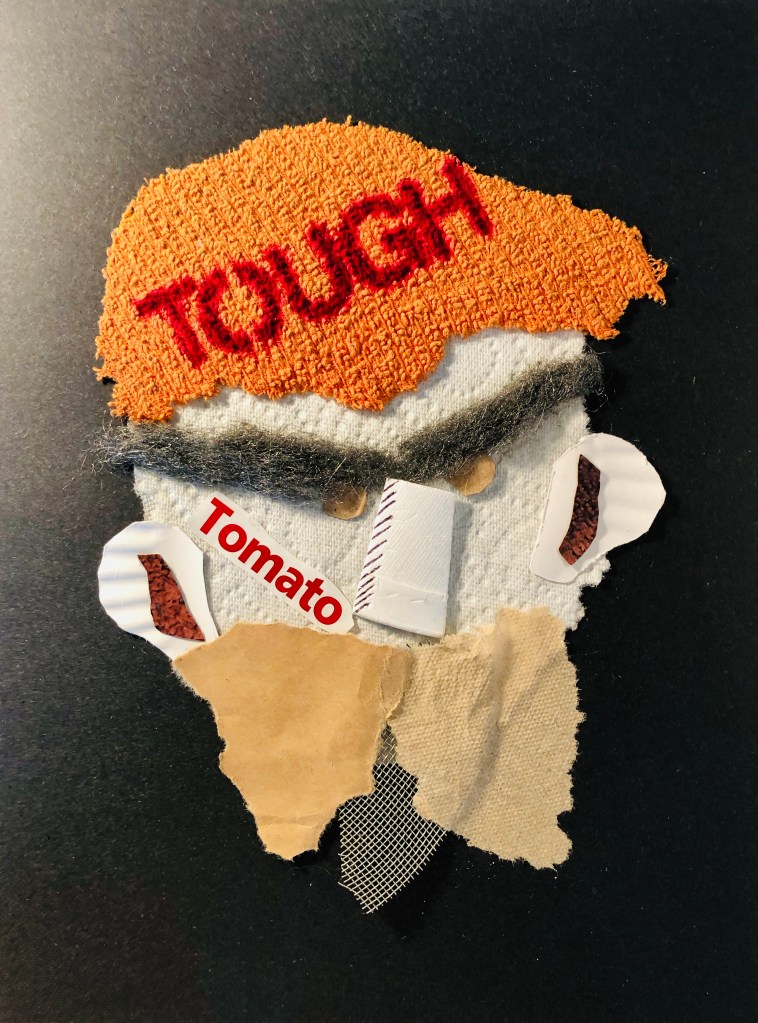
Tough Tomato. Dean Spencer. Collage. What my dad is and we’ve been this week and beyond.

And speaking of young and old, a moment happened this week which reminded me that as I get older I’m happy to report that I care so much less what others think. Which is weird for me since I have spent my life working to make sure people like me. Always. At the cost of much individuality, I have often throughout my years gauged a situation, then not said or done what I was thinking in order to not bring about a conflict. And while this was done in the realm of work and romance for sure, there was definitely drift into my friendships. Over the years, as I feel more comfortable with myself and the people I love (thank you, therapy), I’ve been able to approach my own need-to-please with a little more honest nope-I-don’t-agree-ness. But still, when it came to strangers, my I-want-to-be-liked mechanism would be clocking in at one-hundred-percent. So when this week, I was faced with a neighbor who openly and without mask (she wasn’t wearing one), side-eye smirked me with a pursed mouth, slight head shake, and very tiny eye roll after I said Hello to her, all my innards went a bit crazy. I actually thought whaaaa. did that just happen? then I kept checking myself as a weird sort of freedom rolled in. Where I landed in Hell, yes had a lot to do with the fact that her dislike is based on an ongoing tussle we’re having over how she and her partner treat their dogs i.e., leave them alone for looonnnngg stretches so that they cry a lot and so we’ve not been shy about saying we can hear them and they need to take bette care of them. But regardless, in their eyes, we’re a bother. And this is the first time, no lie, that I’m okay with someone quite clearly not thinking I’m cool or fine or someone to know. Just like last week’s reckoning with my age, this is a new, groundbreaking, atypical feeling for me. And yes, it is unprecedented, but I’d really rather not have used that word.

%$&* Grrr

Available space, Seattle, July 2021

I just finished listening to Rebecca Traister’s book Good and Mad, an exploration of women’s anger in the world of politics and beyond, and boy did it get me going. As I mentioned last year regarding masks and their beauty at allowing me to fully and completely mutter to myself without anyone noticing (muffled inside voice notwithstanding), anyone passing me on the street these last few weeks would have seen a woman of a certain age, bright red over-ear headphones in place nodding and saying things like “exactly” and “hell, yes.” It is the reason the kitchen and living room side of our apartment is almost blindingly clean since I was listening to the chapters on the 2017 MeToo movement and workplace harassment while scrubbing the hell out of the sink and swiffering the floor within an inch of its veneer. In this moment, as I revise my novel, coming face-to-face with the power of anger is one of the things that will float my story of four women and their experience with anger/trauma bravely into a strong current or see it flat like a raft on still waters.

Naturally looking at how anger works in my own life makes my heart beat extra fast. The idea around how all that emotion rises up and has the transformative power to change things has, for me, always been terrifying. Mainly because I feel I don’t know how to control it. Of course “controlling emotion” is a loaded statement and one that has been used to control women since the invention of woman. Anger is the only one of the twelve (the other eleven: Interest, Joy Surprise, Sadness, Disgust, Contempt, Self-hostility, Fear, Shame, Shyness, Guilt) that, when exhibited by a woman outwardly—whether publicly or privately—is intercepted as madness or hysteria or shrillness or name any other poison that will attach to her. In researching what the twelve emotions are, I came across this cool quote in a peer-reviewed research paper, which full-disclosure, I did not read fully but yet am fascinated by the topic: “As psychology transformed from the science of the mind (James 1890Wundt 1897) into the science of behavior (Skinner 1953Watson 1919), an important topic slipped from scientific view: the subjective experience of emotion” (The Experience of Emotion).

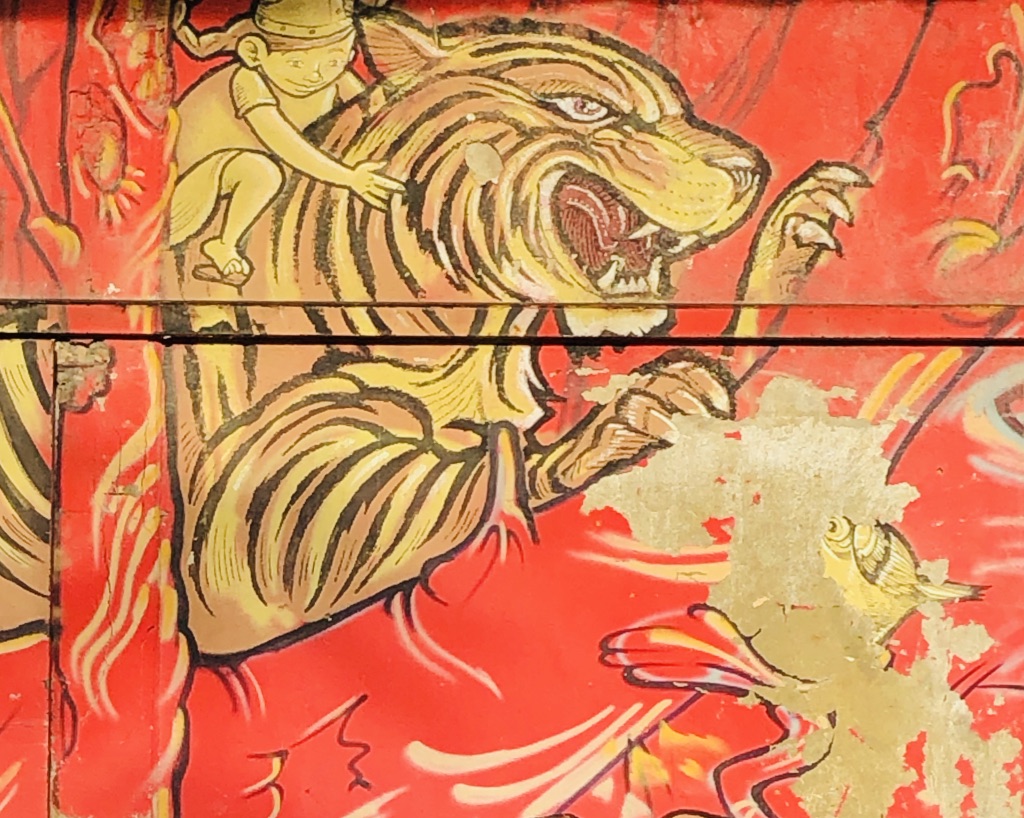
Street art. Lisbon. 2019

Subjectivity: reality as something felt. And there we wrap right back around to anger and its role in the lives of women. How we feel it in our bones, our blood, our bodies. I, personally, have always been crap at it. I know I’ve said/written about it before, I’m afraid of the Vesuvias factor. That my anger will be an explosion/destruction landing on myself or others. In college, I was drawn to a friend because she appeared completely in touch with her anger. Was able to channel it into witticisms and bold actions that I craved for myself. That further into our friendship, her anger unchecked became a more dangerous thing served to confirm my sense that See, that kind of emotion is scary, can hurt people. Whew I dodged that one. Guess I’ll leave this corner of the playground and go stay under the fountain of agreeable. But truthfully, in her life I suspect she was in need of a way to channel it in a healthy way rather than to shut it down altogether.

Healthy. Doing the messy work of excavation. Gaaah. Pulling up all that emotional blacktop, digging, looking at the guts of the thing. Whether with the work of a professional, a course of action, finding guidance private or public, however and whatever support system works, it’s available. Of course it is, even as I’ve always felt embarrassed to even ask. Again, the stigma around women’s anger feels fierce. And how it’s buried I know can be generational. I see women right now unfurling their anger flag high in the air. I know from the movements on the street, online, in the face of so much bullshit toward women that is on display (the trashfire that is Texas. I swear to fucking christ, I’m ready to charter a bus, rent a ranch in New Mexico, hire doctors and begin an underground railroad for women in need. That’s the Lotto winnings I’m looking for.) that we have rage and when channeled it can light a bonfire for change. I went to the pussy marches and screamed my head off with hundreds of other women (and men). The challenge for me is to take this anger project deeper into myself, so that it’s the subtler more personal moments that are given some attention. A way to access the anger inside that is only mine. That will heal me. Move my story forward, which, as happens, will have that ripple, butterfly, domino, slinky effect throughout my world. Wish me luck. I wish you luck too.

Disrupting Traffic

rocka-away

Decades ago I wrote a paper on flâneurs, a French creature (human) who came to prominence in the mid-nineteenth century. He (occasionally she, flâneuse, but fewer of them…) was a dapper figure who strolled slowly, so so slowly, through the streets of Paris sometimes with a turtle on a leash. The turtle set the pace. Now this may sound like performative absurdity, but there was something deeper at play. At the time, the city of Paris was under construction by Georges-Eugène Haussman, hired by Napolean III to recreate the city with wide boulevards, which resulted in the tearing into and destroying of neighborhoods made of winding little streets where, you guessed it, the middle-to-lower classes lived. These wide, sweeping boulevards were meant to stymie protests since throwing up a quick barricade in a small side street took a relatively short amount time and was pretty effective to make a point that the people were angry and wanted to be heard (see Les Mis barricade scene. Yes, it’s a musical). Hence the new avenues: wide enough so that it might take forever to find enough wood for a barricade and big enough for tanks to roll through during celebrations of men’s cockiness (literally). Also straight enough for, as Mark Twain wrote, “a cannonball … [to] traverse from end to end without meeting an obstruction more irresistible than the flesh and bones of men…”. All these grand avenues led to one place, the Arc de Triomphe. (A similar excavation took place in NYC during the era of Robert Moses. Jane Jacobs took him on to a certain extent. No musical. Motherless Brooklyn, the movie, kinda/sorta rolled in The Power Broker about Moses and his, er, cockiness.)

So the flâneur was born. While on one hand an observer of street life, moving so languidly as to take in every. single. crack in the sidewalk. But on the other, they were seen to be protesting how life during the ongoing Industrial Revolution was speeding toward uniformity and anonymity. A pedestrian (the kind that takes two feet) protest of modern life in the city. And while it was true that the person who could afford to do this type of urban disruption was usually exempt from speeding to a job that required them to work their asses off 24-7 in order to eat, their actions got attention, their motives brought discussion. There were poems and writings and general literary wordplay about them. The boulevards did not go away. The pace of life didn’t slow down. The poor and working class still worked their asses off. There was the insurrection of 1871 that created the Paris Commune, a socialistic government that briefly ruled Paris in the spring of that year, but otherwise c’était ça.

Why, you wonder, am I going on about these centuries-old foreign figures? Because it seems to me a pretty good time to reassess involvement in the speed with which the world is turning while also noticing the physical pause we’ve all experienced these last many (many) months. I’ve been wondering whether non-action might be seen as radical action? Or is it rather just a head-buried-in-earth, overwhelmed reflex? So I loved how this op-ed, “Work Is a False Idol” in the NYT, laid out a similar act of protest. “Work has become intolerable. Rest is resistance.” Dubbed the “lying flat” movement, this isn’t a scene populated by well-dressed, economically secure dandy’s strolling in public, this is literally everyday people withdrawing from parts of society that have pounded folx into sad, overworked, overstimulated pulps whether from jobs, news, social media, whatever the poison. Of course there has to be mention of the reality that to those who don’t have a choice, who must roll forward at the speed of sound for many reasons to do with money, security of family, etc., this approach may be seen as entitled. The piece points out though, that there is a very real form of activism and resistance here from all strata. “In the United States, Black activists, writers and thinkers are among the clearest voices articulating this spiritual malaise and its solutions, perhaps because they’ve borne the brunt of capitalism more than other groups of Americans” [Cassady Rosenblum]. 

Being someone who needs to make a living, I’m not so much at liberty to lie flat on the regular, whether metaphorically or literally. But I do absolutely appreciate the sentiment of making the changes I can as the world feels both paralyzed and propelled—one half on fire and drought, the other drowning in too much rain and fierce wind; and death, destruction, war games, etc. on the planet overall. What to pay attention to? How to help? Where to conserve energy and do the best as a ripple effect out from myself to the rest of the planet? I have no concrete answers for any of this. I do notice though that adjusting to life away from tall buildings with offices (something I shifted away from pre-pandemic) brings the missing of certain interactions and the wearing of outfits but it’s also lowered teeth-gritting moments and the recurring visions I would have of me lying flat on my back in the middle of a room—or wherever—just giving up.

Giving up. Not a bad thing in measures. I’ve given up the salary of a somewhat high scale for a lesser wage that still keeps me under a roof and lets me decide a bit on my hours so I can write and hang with my dad. I can also swim three mornings a week, a newly discovered passion thanks to the local Y. Yes, I own goggles. No, I haven’t worked out any sort of Katie Ledecky free-style breathing technique. I’m just managing to move forward and it feels really effin’ good. I also get to take very long strolls around this town, wandering by big houses, small houses, into parks and a cemetery, while listening to podcasts and making up stories about the people who live here. A bit of a flâneuse activity. A certain amount of pushback against over-scheduling. Money and survival not far from my brain most the time, but the downshifting is noticeable emotionally. The trick is to remind myself that it is my decision how much or little I want to take on given the parameters of need and time. Being used to always saying Yes. Being crap at keeping guilt at bay as the world devolves and I think I have to do something. This last can be a bit of an ego trip so overall it’s a choose your battles kind of moment. I will not be taking a turtle for a walk. I will be supporting the lying flat movement in my own special way. To all you reading this and out from there, I wish the same!!!

Climbing a Hill*

Close-up

I’m thinking big picture/small details. Forest/trees.

Current and ongoing global moments are relentlessly heartbreaking. You all know what they are. It’s August 2021 and not only people but the planet is hurting. Twelve months ago was not much different. My post on August 23, 2020, was titled “On Choosing” and started like this: “For the last many months, taking in news global, national, and local has been like living in a dystopian novel where Diamond Dogs is playing on a loop in the background: unsettling with weird moments of beauty. While I actually typed a list of those events here, I just erased the whole of it since it ate up the rest of my blog space like a Ms. Pac-Man gone berserk.”

Hello, here&now. August 2021. While the past year has certainly seen some progress (I’m looking at you, vaccines and new administration), it’s also had its share of looping back on itself (hey there, Delta/Covid/masks up and fires blazing in the west). Today though, there’s a big scoop of fatigue swirled on top of my mental sundae, drizzled with a sense of What Next…? I’ve no doubt a majority of us have a spoon stuck in that mindset. With myriad servings of humanitarian and climate crises, one does get placed on top of another, so I find myself searching for a way in before everything melts down.

Last year, while the crises in all their shapes and forms did not feel manageable in the traditional definition of that word, there was a visceral energy in watching folx move en-masse, raising voices, footsteps, and fists to deliver messages of Hell-No-More after George Floyd’s murder. I was committed to examining the racial biases inside myself, a process ongoing. I could understand, respect, follow COVID lockdown and safety measures. Work toward and worry over the 2020 election bringing in a new administration.

pan out

Leap frog a year and fresh crises mingle with the old. Also new discoveries. This time my generosity and compassion reflex has bubbled up a deeply personal realization. While the crisis in Afghanistan around women and girls has me looking for ways to help (see below for a few), a funny thing happened on the way to this particular altruism: I tripped over my own woman-girl issue. Mothers and daughters. It feels redundant, unnecessary, to use the word complicated alongside the pairing. In my family tree, I’ve been ignoring the roots while wrestling with the individual branches. In so doing, I’ve been swinging from emotion to emotion without paying attention to how I’d lost sight of the ground, what lies below, what keeps the whole thing upright. I’d become increasingly focused on showing how I could climb higher, be more than she, compete for better-person award. In that process, I forfeited grace and compassion inside our relationship. Where this competition began is the stuff of many therapy sessions, but in the immediate, the game is doing me no good. The scars of the past—her mom’s, hers, mine—are each of ours to carry, but they do blend together in our DNA. And they aren’t things to be fixed, but rather moments to be understood, listened to, lived with. By stepping off the emotional court of competition and onto the sidelines where I can support rather than slam away to score the next point, I hope I can make more space for the needs of the woman and girl inside me so she and I can have room to get stronger. In turn, I also hope my commitment to other women and girls can grow stronger in the learning. I can come closer to understanding that the ties that bind are so much more than a problem to be solved, a fixed point with a finish line, and are instead the ongoing struggle to be seen, heard, and taken care of in whatever way we can help each other to do that.

Ways to help Afghan women and girls in the immediate (these have been vetted through charity navigator, although Women for Afghan Women does not have a score, there is a breakdown of culture and community around the org that’s helpful):

Women for Afghan Women

Women for Women International

Overall ways to help the Afghan people are listed in this NYTimes article.

And a few to support women and girls in the US:

The Loveland Foundation

Girls Write Now

WriteGirl

Pace Center for Girls (my mom sent me this one)

1968: my mom’s mom (background), her & I (foreground)
  • inspiration paid: Amanda Gorman’s “The Hill We Climb” (read it/revisit it here.)